
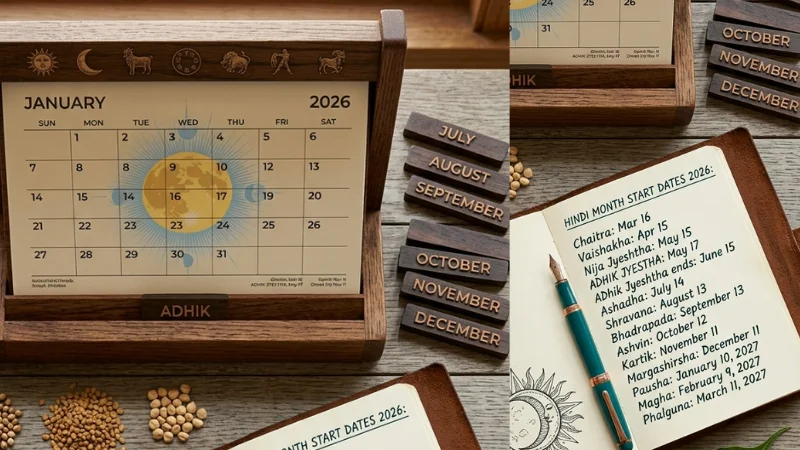
Desk Calendar vs. Wall calendar, What works best?
There is something a wall calendar cannot do. It stares at you from across the room, general and distant, while your actual work happens three inches from your hands. A desk calendar 2026 sits right where you think — at arm’s reach, at eye level, in the middle of everything that actually matters in your day.
That is why people who swear by desk calendars are rarely people who forget things. They are usually people who write things down, which is a completely different relationship with time.
This guide covers every format, every size, and every buying decision worth making for a desk calendar in 2026. It also does something no other guide bothers to do: it gives you the exact Hindi month start dates mapped to your desk calendar grid, because 2026 is not a standard calendar year for millions of Indian families — it has 13 months, not 12, and that changes how you plan.

WHY 2026 IS DIFFERENT FROM ANY RECENT YEAR
Before we talk paper weights and spiral binding, one fact about 2026 deserves your attention.
The Hindi lunisolar calendar adds an intercalary month — called Adhik Maas — roughly every 2.5 to 3 years, to keep the lunar year aligned with the solar year. In 2026, that extra month is Adhik Jyeshtha, running from May 17 to June 15. This means the Hindi calendar in 2026 has 13 months, and almost every major festival shifts slightly from where it fell in 2025.
If your family observes festivals — Diwali, Raksha Bandhan, Ganesh Chaturthi, Eid, or even just the Panchang-determined auspicious dates for weddings and new beginnings — your 2026 desk calendar needs space for these dates to be annotated clearly. That is the practical case for choosing a large desk calendar format this year over a compact one.
Best calendar formats 2026— AND WHO EACH ONE IS FOR
People searching for a desk calendar 2026 usually don’t know there are six distinct formats sold under that label. Knowing the difference saves you from returning something in January.
The Desktop Pad Calendar
This is what most people picture. A stack of pages, typically 22×17 inches or 17×11 inches, spiral or wire-bound at the top, with a monthly grid on each page. You flip one page per month and use the current month as a writing surface under your keyboard, notepad, or coffee cup.
The 22×17 format gives you roughly a 2×2 inch cell per day — enough for three or four line items. The standard desk calendar 22×17 is the workhorse of office planning. At a glance desk calendar 2025 and 2026 editions from brands like AT-A-GLANCE typically come in this format with ruled blocks and Julian dates printed in the corner, which is useful for anyone tracking project timelines.
The Daily Desk Calendar
A daily desk calendar gives you one page per day — or sometimes one day across a two-page spread. These are the formats with actual space: space to write meeting notes, tasks, follow-ups, and reminders without abbreviating everything into a symbol only you understand.
If your work involves client calls, billing hours, or anything that requires a written record of what happened on a specific date, a daily desk calendar 2025 or 2026 format is worth the thicker profile. The desk calendar box format — where pages tear away and stack below — falls in this category. You pull off yesterday and it becomes scratch paper. Satisfying in a way that calendar apps genuinely cannot replicate.
The Large Desk Pad Calendar
This is less a calendar and more a workspace. A large desk pad calendar 2025 or 2026 version spans the majority of your desk surface — some run 24×17 inches. The monthly grid is printed at a size where you can write in full sentences, not shorthand.
These formats are popular with creative professionals, architects, teachers writing lesson plans, and anyone who thinks visually. The desk also becomes the planning surface. Notes go directly onto the date. Colour coding is natural because you have the space for it.
The paper weight matters more here than in any other format. Cheaper versions bleed through from markers and some pens. Look for pads that specify at least 70lb paper stock if you use anything other than ballpoint.
The Perpetual Desk Calendar
Less common but worth mentioning — the desk perpetual calendar has no year printed on it. Each month tile or block is repositioned. These are often wooden, made for people who dislike disposable stationery and want an object on their desk that doesn’t get thrown away in December.
The practical downside is that perpetual desk calendars rarely show holidays, moon phases, or any pre-printed reference information. You write everything in. For people who need festival and holiday annotations — including Hindi month markers — these require more setup effort.

CALENDAR SIZE AND FORMAT: THE DECISION THAT MATTERS MOST
The standard desk calendar 22×17 is the most common, but it isn’t always the most useful. Here is a simple way to decide:
If your desk is under 48 inches wide and you share it with a monitor, peripherals, and regular paperwork, a 17×11 format will fit without dominating. If you have a dedicated writing surface or a large office desk with room, the 22×17 or larger pad calendar gives you the planning real estate to actually see a month at once.
The vertical desk calendar is a newer format — a narrow, tall calendar that stands at the back of the desk rather than lying flat. These work well in compact workspaces and are increasingly popular in home offices where surface area is limited.
For best decision making during buying Indian vegetable seeds in USA during Rabi and Kharif months ,you need to get aware of these local variants of Hindi month names so you may understand what your elders teach from the centuries old planting practices they know about.
BINDING: SPIRAL, WIRE-O, AND STAPLE
This is where most buyers don’t read carefully and end up frustrated.
Spiral binding (plastic coil) is the most common and the cheapest. It works fine for 12 months of normal flipping. The coil can snag on things over time but holds up for a year.
Wire-O binding (the twin-loop metal binding) lies perfectly flat when open and flips cleaner. This is what AT-A-GLANCE and most professional-grade desk calendars use. If the calendar is going to live on your desk all year and flip repeatedly, wire-O is worth the slight price increase.
Staple-bound desk calendars are the most budget-friendly and the least durable. Fine for occasional reference, less useful if you’re writing in it daily.
BULK DESK CALENDARS: WHAT CORPORATE BUYERS NEED TO KNOW
If you’re purchasing bulk desk calendars for an office, a team, or as corporate gifts, the pricing math changes significantly. Most major calendar retailers and stationery wholesalers offer volume pricing starting at quantities of 25 or more.
For 2026 specifically, buyers ordering for corporate use should note that some formats sell out between October and December of the preceding year. Ordering desk calendars 2025 in Q3 2025 and 2026 editions from October 2025 onwards is the standard practice for uninterrupted supply.
The most commonly gifted format for corporate use is the daily desk calendar with the company logo printed on the cover — a service most specialist calendar printers offer with a minimum run of around 50 units.
WHAT NOBODY MARKS ON THEIR DESK CALENDAR: THE 2026 HINDI MONTH START DATES

Here is where this guide earns its keep for the large portion of readers who observe both calendar systems — Gregorian for work, Hindi lunar for family life, festivals, and auspicious planning.
Standard desk calendars 2026 will not show you when Chaitra begins, when Adhik Jyeshtha falls, or when Kartik — the month of Diwali — starts. You have to add these yourself.
Below are the Hindi month start dates for 2026, formatted exactly so you can mark them on any desk calendar grid:
Chaitra begins: March 16, 2026
Vaishakha begins: April 15, 2026
Jyeshtha (Nija, the regular month) begins: May 15, 2026
Adhik Jyeshtha begins: May 17, 2026 — THIS IS THE EXTRA MONTH
Adhik Jyeshtha ends: June 15, 2026
Ashadha begins: July 14, 2026
Shravana begins: August 13, 2026
Bhadrapada begins: September 13, 2026
Ashvin begins: October 12, 2026
Kartik begins: November 11, 2026
Margashirsha begins: December 11, 2026
Pausha begins: January 10, 2027
Magha begins: February 9, 2027
Phalguna begins: March 11, 2027
Mark these in a different colour on your desk calendar. Use a small “H” notation in the corner of each cell if you want to keep it subtle. These 13 transitions represent every major shift in the ritual, agricultural, and festival cycle that governs Indian cultural life — and having them visible on your physical planning calendar makes dual-system planning genuinely practical rather than something you look up every time.
For a complete printable version of the 2026 Hindi calendar with all 13 months, English dates, and festival annotations, the downloadable PDF at monthnameshindi.com/hindi-month-calendar-2026 has everything formatted for print.
THE PRACTICAL BUYING CHECKLIST FOR 2026
Before you order, run through these five:
- One — Paper weight. If you use gel pens, fountain pens, or markers, check that the pad specifies 60lb or higher. Thin paper bleeds and ruins the month underneath.
- Two — Grid cell size. For a desk calendar you actually write in daily, the minimum useful cell size is 1.5 x 1.5 inches. Anything smaller becomes illegible within a week.
- Three — Reference information. The best desk calendars 2026 print moon phases, week numbers, and the previous/next month in small print — genuinely useful for scheduling without pulling up a separate tool.
- Four — Holiday pre-printing. US federal holidays are standard. If you need Indian public holidays or regional observances pre-printed, specialist calendar makers like those listed in our full 2026 Indian calendar guide carry these formats.
- Five — Binding direction. Top-bound pads flip up and back. Side-bound pads flip left like a book. This matters depending on how you position the calendar relative to your dominant hand and monitor.
WHY PHYSICAL DESK CALENDARS CONSISTENTLY OUTPERFORM DIGITAL FOR DAILY PLANNING
This is worth saying plainly because the question comes up every year.
A study from the University of Tokyo published in Frontiers in Behavioral Neuroscience (2021) found that writing information on paper activates regions of the brain associated with memory encoding more deeply than typing the same information into a device. The researchers used MRI imaging and found that handwritten notes produced 25% more neural activity in memory-related areas than digital note-taking under the same conditions.
That is not an argument against Google Calendar. It is an argument for using both. The desk calendar captures decisions in the moment — in a meeting, during a call, between tasks — without requiring a device unlock, an app load, or a synchronisation delay.
The paper desk calendar is also the only planning tool that is visible to everyone in a shared workspace simultaneously, which matters for any team or household where coordination is the real challenge.
In some households alarge whiteboard wall calendar is often seen ,it allows to manually annotate Hindi lunar months in one color and Gregorian appointments in another.
The traditional dates from Kalnirnay and the deadlines from phone get transferred to a shared erasable surface, syncing the cultural and professional parts of life for a whole family .
CLOSING: THE CALENDAR THAT ACTUALLY GETS USED
The best desk calendar 2026 is not the most expensive one. It is the one that sits on your desk every day and gets written in — marked, crossed through, added to, and referred to without effort.
For most people, that means a standard 22×17 monthly pad with wire-O binding and adequate cell size. For people tracking two calendar systems — Gregorian and Hindi — it means a large format with space to annotate, and the 13 Hindi month start dates marked from day one.
2026 is an unusual year in the Hindi calendar. The Adhik Maas makes it longer, shifts festival dates, and gives families one extra month to plan around. A desk calendar that has those dates marked from January is not just a planning tool — it is the kind of quiet daily reminder that keeps cultural memory alive, one handwritten note at a time.