
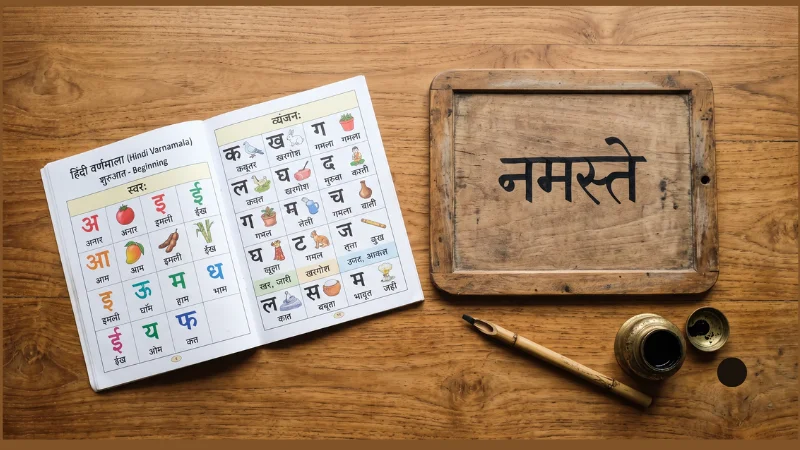
Hindi Alphabet (Varnamala) – All 52 Letters & Pronunciation
हिंदी वर्णमाला
All 52 Hindi letters — vowels, consonants, pronunciation, Devanagari chart and how to write. The most complete reference for learners, students and teachers. To understand truly month names in Hindi you must first understand these Hindi Alphabets.
52
Total Letters
13
Vowels (Swar)
39
Consonants
5
Consonant Groups

The Hindi alphabet, called Varnamala (वर्णमाला), is the writing system used for the Hindi language. Written in Devanagari script, it reads left to right. Varnamala comes from Sanskrit — varna (letter) + mala (garland). It contains 52 letters total: 13 vowels (Swar) and 39 consonants (Vyanjan). Unlike English, every Hindi letter has exactly one fixed sound — making it one of the world’s most phonetically precise scripts.
13
Vowels
स्वर (Swar)
.
33
Basic Consonants व्यंजन (Vyanjan)
.
4
Semi-vowels अन्तःस्थ
4
Sibilants ऊष्म
.
3
Compound Letters क्ष, त्र, ज्ञ
.
स्वर
Hindi Vowels
— स्वर (Swar)
Hindi has 13 vowels called Swar (स्वर). Each is a sound produced without any obstruction of airflow. They appear both as standalone letters and as Matra signs attached to consonants.

The inherent vowel rule
Every Hindi consonant carries an inherent अ (a) sound by default. When any other vowel follows a consonant, a Matra sign is used instead of writing the full vowel letter. This is why mastering Matras is just as important as learning the vowels themselves.
13
स्वर — Swar (Vowels)
Sounds produced with open vocal tract — 13 letters total.
a
as in ‘about’
aa
as in ‘father’
i
as in ‘bit’
ee
as in ‘feet’
u
as in ‘put’
oo
as in ‘food’
ri
Sanskrit vowel
e
as in ‘they’
ai
as in ‘fair’
o
as in ‘go’
au
as in ‘now’
an/am
nasal vowel
ah
breath aspirate
Short and long vowels
Hindi vowels come in pairs — short (laghu) and long (dirgha). Short vowels like अ, इ, उ are held briefly. Long vowels like आ, ई, ऊ are held roughly twice as long. This distinction changes meaning: दिन (din = day) vs दीन (deen = poor/humble).
व्यंजन
Hindi Consonants
— व्यंजन (Vyanjan)
Hindi has 39 consonants organized into 5 groups by articulation point — where in the mouth the sound is made. This scientific arrangement is one of the most logical systems in any writing tradition.

Why the arrangement makes sense
Ancient Indian linguists arranged consonants from the back of the throat (velar) to the lips (labial). Within each group of 5, the pattern is always: unaspirated → aspirated → voiced unaspirated → voiced aspirated → nasal. Once you learn this pattern for one group, you understand all five.
5 Letters
क वर्ग — Ka Varga
Velar / Kanthya (कण्ठ्य) — sounds formed in the throat/back of mouth

ka
as in ‘king’
kha
breathy K
ga
as in ‘girl’
gha
breathy G
nga
as in ‘sing’
cha
as in ‘chair’
chha
breathy CH
ja
as in ‘jar’
jha
breathy J
nya
as in ‘canyon’
ta
retroflex T
tha
breathy retro-T
da
retroflex D
dha
breathy retro-D
na
retroflex N
ta
soft ‘th’ in ‘the’
tha
breathy dental-T
da
soft D in ‘and’
dha
breathy dental-D
na
as in ‘now’
pa
as in ‘pen’
pha
breathy P / ‘phone’
ba
as in ‘bat’
bha
breathy B
ma
as in ‘mat’
ya
as in ‘yes’
ra
rolled R
la
as in ‘lord’
va/wa
between V and W
sha
as in ‘shoe’
sha
retroflex SH
sa
as in ‘sun’
ha
as in ‘hat’
ksha
क्+ष् combined
tra
त्+र् combined
gya / jña
ज्+ञ combined
उच्चारण
Pronunciation Guide
— उच्चारण
One of Hindi’s greatest advantages: each letter has exactly one fixed, unchanging sound. Once you learn the 52 sounds, you can read any Hindi word correctly — even without knowing its meaning.

The aspirated vs unaspirated key
Hindi distinguishes aspirated sounds (with a puff of air — kh, gh, bh, ph) from unaspirated (no air — k, g, b, p). In English, say “pit” vs “spit” — the P in “spit” is unaspirated. That softer P is closer to how Hindi प sounds. This single distinction separates words like पल (pal = moment) from फल (phal = fruit).

| Letter | Roman | Matra | English equivalent | Example word |
|---|---|---|---|---|
| अ | a | — | Short schwa — like ‘a’ in ‘about’ | अब (ab = now) |
| आ | aa | ा | Long A — as in ‘father’ | आम (aam = mango) |
| इ | i | ि | Short I — as in ‘bit’ | इधर (idhar = here) |
| ई | ee | ी | Long EE — as in ‘feet’ | ईश्वर (ishwar = God) |
| उ | u | ु | Short U — as in ‘put’ | उन (un = those) |
| ऊ | oo | ू | Long OO — as in ‘food’ | ऊन (oon = wool) |
| ऋ | ri | ृ | No direct equivalent — rolled RI | ऋषि (rishi = sage) |
| ए | e | े | Like ‘A’ in ‘they’ | एक (ek = one) |
| ऐ | ai | ै | Like ‘A’ in ‘fair’ | ऐनक (ainak = glasses) |
| ओ | o | ो | Like ‘O’ in ‘go’ | ओर (or = direction) |
| औ | au | ौ | Like ‘OW’ in ‘now’ | औरत (aurat = woman) |
| अं | an/am | ं | Nasal vowel — like French ‘un’ | अंग (ang = body part) |
| अः | ah | ः | Slight breathy H at end | नमः (namah = greetings) |

संख्या
How Many Letters Are in the Hindi Alphabet?
This is one of the most searched questions about Hindi — and the answer depends slightly on which counting tradition is used.

The standard modern count is 52 letters: 13 vowels + 33 basic consonants + 3 compound consonants (क्ष, त्र, ज्ञ). Older textbooks sometimes list 56 letters by adding ळ and letters borrowed from Persian (ज़, ख़, etc.). The NCERT curriculum — India’s national standard — uses 52.
| Category | Hindi name | Count | Examples |
|---|---|---|---|
| Vowels | स्वर (Swar) | 13 | अ, आ, इ, ई, उ, ऊ, ऋ, ए, ऐ, ओ, औ, अं, अः |
| Velar group | क वर्ग | 5 | क, ख, ग, घ, ङ |
| Palatal group | च वर्ग | 5 | च, छ, ज, jh, ञ |
| Retroflex group | ट वर्ग | 5 | ट, ठ, ड, ढ, ण |
| Dental group | त वर्ग | 5 | त, थ, द, ध, न |
| Labial group | प वर्ग | 5 | प, फ, ब, भ, म |
| Semi-vowels | अन्तःस्थ | 4 | य, र, ल, व |
| Sibilants | ऊष्म | 4 | श, ष, स, ह |
| Compound | संयुक्त | 3 | क्ष, त्र, ज्ञ |
| Total (NCERT standard) | 52 | Per modern Hindi textbooks | |

How to Write in Hindi — Devanagari Basics
Before picking up a pen or keyboard, these five concepts give you a complete foundation for writing in Hindi script.
Write left to right
Hindi reads and writes from left to right, exactly like English. Unlike Arabic or Urdu, there is no right-to-left direction. Line direction is the first thing to confirm for new learners.
Understand the Shirorekha (शिरोरेखा)
Every Hindi letter hangs from a horizontal line across its top, called the Shirorekha — literally “head line.” This connecting line runs across words and is what gives Devanagari its distinctive flowing appearance. It is written as part of each letter or as a continuous stroke across a word.
Learn stroke order
Hindi letters are built from specific stroke sequences. Most are written top to bottom, left to right. The Shirorekha is typically drawn last or as a single continuous pass. Children in India learn stroke order through 2-line notebooks specifically ruled for Devanagari practice.
Add Matras for vowels
When a consonant is followed by any vowel other than the inherent a, a Matra sign is added to the consonant. For example, क(ka) + the aa-matra becomes का(kaa). Matras attach above, below, left or right of the base letter depending on which vowel they represent.
Use Halant to suppress the inherent vowel
The Halant symbol (्) sits below a consonant to remove its inherent a. This is essential when two consonants must appear together with no vowel between them — for example, forming conjunct consonants like क्ट (kta).
Also on this site: Hindi Month Names
Now that you know the alphabet, see all 12 Hindi month names written in Devanagari — with pronunciation and calendar details.
See Hindi Month Names →

Vowel Signs — मात्राएं (Matras)
Matras are vowel signs attached to consonants. Read the consonant sound first, then the vowel. Each matra below uses क(ka) as the base consonant to show placement.
Apply Your Matra Knowledge!
Now that you have mastered vowel signs, see how these exact matras form the names of traditional calendar months like Chaitra (चैत्र) and Vaishakha (वैशाख) in our comprehensive guide to Hindi Month Names.
प्रश्नोत्तर
Frequently Asked Questions
The most common questions about the Hindi alphabet, script and pronunciation — answered directly.
How many letters are in the Hindi alphabet?
The Hindi alphabet (Varnamala) has 52 letters in the standard modern count: 13 vowels (Swar) and 39 consonants (Vyanjan), which includes 3 compound consonants (क्ष, त्र, ज्ञ). Older textbooks sometimes list 56 by including additional letters borrowed from Persian or Arabic (ज़, ख़, ग़, फ़). India’s NCERT curriculum uses the 52-letter count.
What is the Hindi alphabet called?
The Hindi alphabet is called Varnamala (वर्णमाला). The word comes from Sanskrit: Varna (वर्ण) meaning “letter” and Mala (माला) meaning “garland.” So Varnamala literally means “garland of letters.” It is written in the Devanagari script, which is also used for Sanskrit, Marathi, and Nepali.
What are the vowels in Hindi?
Hindi has 13 vowels called Swar (स्वर): अ, आ, इ, ई, उ, ऊ, ऋ, ए, ऐ, ओ, औ, अं, and अः. They include 5 short/long pairs (अ/आ, इ/ई, उ/ऊ), the Sanskrit vowel ऋ, two diphthongs (ए/ऐ, ओ/औ), and two additional sounds — the Anusvara (अं) and Visarga (अः).
What does “Devanagari” mean?
Devanagari (देवनागरी) means “script of the city of the gods.” It comes from Deva (divine) + Nagari (city). It is one of the world’s most widely used writing systems, serving Hindi, Sanskrit, Marathi, Nepali, Bodo, Maithili, and several other South Asian languages. The script dates to around the 11th century CE, though its parent scripts are much older.
Is Hindi written left to right?
Yes. Hindi is written left to right, in the same direction as English. This often surprises new learners who expect all Asian scripts to read differently.
Interestingly, Urdu—which shares a nearly identical spoken vocabulary with Hindi—uses the Nastaliq script and reads right to left. This historical split of the same spoken language into two opposite writing directions is one of the most unique features of South Asian linguistics.
How is Hindi different from the English alphabet?
The key structural differences between the Hindi and English alphabets are:
Letter Count: Hindi has 52 letters compared to English’s 26.
Phonetic Consistency: Every Hindi letter represents exactly one fixed sound. Unlike English, a letter never changes its pronunciation based on context.
The Shirorekha: Hindi letters hang from a horizontal line (Shirorekha) drawn across the top.
Aspiration: Hindi distinguishes between aspirated sounds (like kh, gh, bh) and unaspirated ones (like k, g, b).
Retroflex Consonants: Hindi contains retroflex sounds that have no English equivalent.
Is Hindi difficult to learn for English speakers?
The US Foreign Service Institute classifies Hindi as a Category III language, estimating that it requires roughly 1,100 hours of study to reach professional proficiency.
The most challenging elements for English speakers include:
Retroflex consonants (sounds made by curling the tongue backward)
The aspirated vs. unaspirated phonetic distinction
Mastering the Devanagari script
Gendered nouns
However, Hindi’s perfect phonetic consistency—where one letter always equals one sound—makes pronunciation and spelling much easier to master than English once you learn the basic 52 sounds.
What is the difference between the Hindi and Sanskrit alphabets?
While both languages use the Devanagari script, there are key differences:
Vowel Set: Sanskrit features a larger vowel set, including long ॠ, ऌ, and long ॡ, which are rarely or never used in modern Hindi.
Sound Simplification: Hindi has simplified several classical Sanskrit pronunciations.
Foreign Influence: Hindi has integrated external sounds from Persian and Arabic (such as ज़, ख़, फ़) that do not exist in classical Sanskrit.
Essentially, the Hindi alphabet acts as a practical, modernized subset of Sanskrit’s historical phonological system.
What makes retroflex consonants unique?
Retroflex sounds (ट, ठ, ड, ढ, ण) do not exist in English. To produce them, you curl the tip of your tongue backward so the underside touches the roof of your mouth (hard palate). These sounds are distinct from dental consonants (where the tongue touches the upper teeth) and give South Asian languages their distinct phonetic character.
What are the compound consonants in Hindi?
Compound consonants (Sanyukt Vyanjan / संयुक्त व्यंजन) are formed when two distinct consonants combine to create a single letters-unit. The three primary compound consonants in standard modern Hindi are:
क्ष (ksha): Combined from क + ष
त्र (tra): Combined from त + र
ज्ञ (gya/jna): Combined from ज + ञ
Because these are sometimes counted in the main alphabet and sometimes categorized separately, you will see sources listing the total Hindi letter count as 49, 52, or 56. The modern NCERT standard remains 52.
What are the basic rules for writing in Hindi Devanagari script?
If you are learning to write in Hindi, these five foundational concepts are essential:
Write Left to Right: The writing flow matches English.
Understand the Shirorekha (शिरोरेखा): Every letter hangs from a horizontal line drawn across its top. This connecting line runs across whole words to give Devanagari its signature flowing look.
Learn the Stroke Order: Letters are written top-to-bottom and left-to-right. The top horizontal line (Shirorekha) is always drawn last.
Use Matras for Vowels: When a consonant is paired with any vowel other than the inherent short a, a Matra (vowel sign) is added above, below, left, or right of the consonant.
Use Halant to Suppress Vowels: Consonants have an inherent short a sound. Writing a small diagonal stroke called a Halant (्) underneath a consonant strips away this vowel sound, allowing you to join consonants together.