
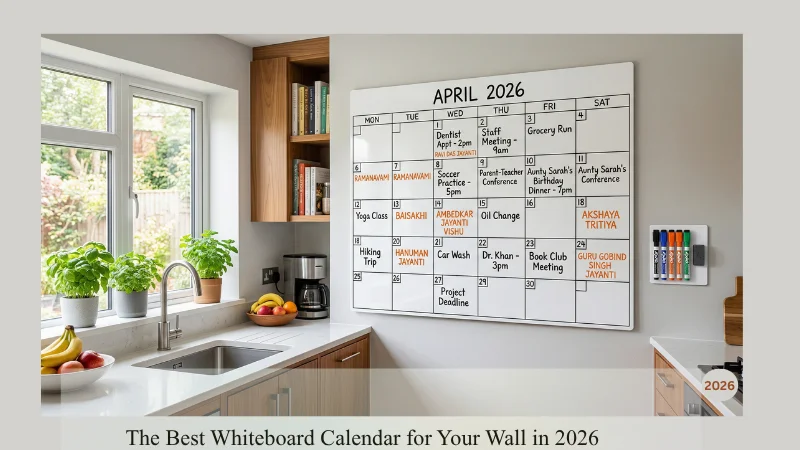
THE BEST WHITEBOARD CALENDAR FOR YOUR WALL IN 2026
A whiteboard calendar is the only planning tool in your home that never runs out of space. You erase Tuesday. You rewrite it. You move Saturday to the following week. No crossing out, no sticky notes layered on top of each other, no month that looks like a crime scene by day fifteen.
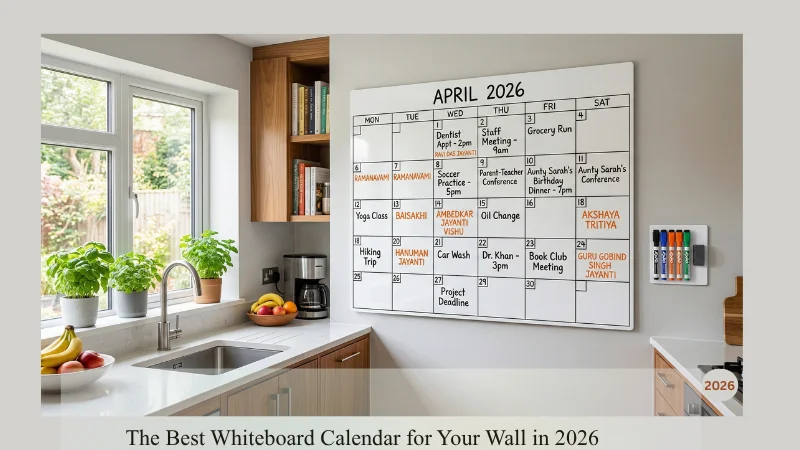
That erasability is not a small thing. It is the entire philosophy. Life changes faster than any printed calendar anticipated when it left the press in October, and a reusable wall calendar acknowledges that honestly in a way that a paper calendar never can.
This guide covers every format of whiteboard calendar available in 2026 — dry erase boards, magnetic surfaces, glass panels, and chalkboard alternatives — with concrete guidance on size, surface quality, and the one use case most buying guides completely ignore: using a large dry erase wall calendar to track two calendar systems simultaneously, which is exactly what millions of Indian diaspora households in the US, UK, and Canada need to do every single year.
WHY A WHITEBOARD CALENDAR OUTPERFORMS PAPER FOR LONG-TERM PLANNING
There is a straightforward environmental case for a reusable wall calendar: one whiteboard lasts years, while a paper calendar lasts one. But the practical case is more compelling.
A research paper published in the British Journal of Educational Technology (Nicol & Macfarlane-Dick, 2006, updated in applications by educational psychologists through 2022) found that visual planning tools that allow iteration — the ability to change, move, and revise — are significantly more effective for complex scheduling than static displays. The act of erasing and rewriting reinforces a decision consciously rather than just crossing something out and hoping.
That cognitive loop — write, review, erase, rewrite — is exactly what makes an erasable whiteboard calendar effective for families, project managers, teachers, and anyone whose schedule is genuinely complex rather than predictable.
The other advantage is visibility. A large dry erase wall calendar in a shared space becomes a household communication tool, not just a personal planner. Everyone in the room can see it. Changes are immediate. There is no version control problem, no “I didn’t see the calendar app update.”
THE SURFACE QUESTION: FIVE FORMATS, FIVE DIFFERENT EXPERIENCES
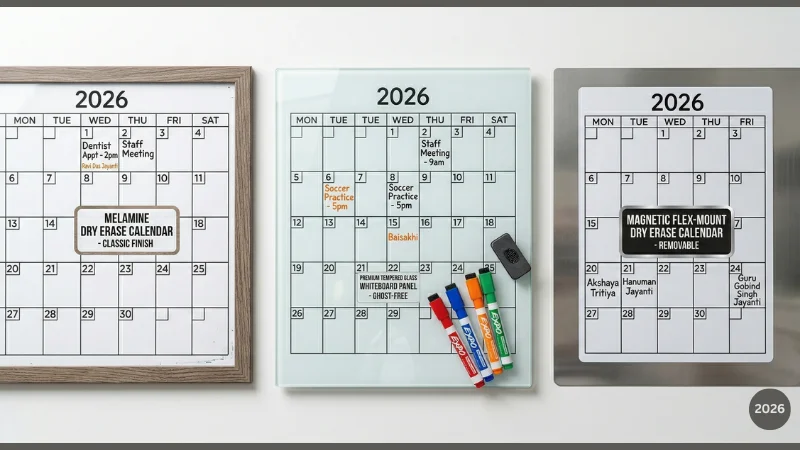
Every wall calendar dry erase product on the market falls into one of five surface types. The surface determines everything — how well it writes, how cleanly it erases, whether ghosting becomes a problem after three months, and how it looks on your wall.
Standard Melamine Whiteboard Surface
This is the entry-level whiteboard calendar material. Most affordable large dry erase calendars for walls use melamine over particleboard. Writes well initially. Erases acceptably for the first few months. The problem is ghosting — the faint residue of previous writing that builds up over time and makes the surface look perpetually dirty. A melamine surface will ghost visibly within four to six months of regular use, no matter how good your markers are.
Fine for a temporary planning board. Not ideal for a permanent fixture you want looking clean twelve months later.
Painted Steel (Porcelain or Magnetic)
A step above melamine, painted steel surfaces — including the category sold as magnetic dry erase wall calendar panels — combine whiteboard functionality with magnetic receptivity. This means you can pin notes, photos, or colour-coded index cards directly to the surface alongside your written calendar grid.
Porcelain on steel is the premium version. It does not ghost. Markers wipe clean with a dry cloth even after weeks. It is heavier, more expensive, and genuinely worth the investment if the calendar is going in a family kitchen or office where it will be used every single day. Ghost-free surfaces from brands like Quartet, Ghent, and MooreCo all use this construction.
Tempered Glass Whiteboard Calendar
Glass whiteboards are the most aesthetically refined option in the whiteboard calendar category. A glass dry erase surface wipes completely clean every time, never ghosts, never stains, and looks architectural on a wall — nothing like the utilitarian whiteboard in a conference room.
The surface is non-porous at a molecular level, which is why it erases so completely. Markers do not penetrate; they sit on top. A single cloth wipe removes everything.
The trade-off is installation weight and cost. Tempered glass panels are heavy. Most require wall anchoring into studs, not just drywall. The price is typically two to three times the equivalent melamine panel. But if your whiteboard calendar is going in a home office or a designed living space where appearance matters, this is the surface that does not look like office furniture.
Acrylic Wall Calendar
A growing segment of the market — acrylic whiteboard calendars use clear or frosted acrylic sheet in place of traditional whiteboard materials. These are typically frameless, lighter than glass, and often sold in elegant designs that double as wall decor. We cover this format in detail in our companion guide to acrylic wall calendars.
Chalkboard Wall Calendar
A chalk wall calendar is technically distinct from a dry erase surface — chalk and chalk markers are not whiteboard markers — but the category of erasable, reusable planning boards includes both. The chalkboard wall calendar aesthetic is warm, textured, and popular in kitchens and children’s rooms for precisely the reason that makes it inefficient for dense planning: chalk text is softer, slightly harder to read at a distance, and messier to erase than dry erase.
Use a chalkboard wall calendar for monthly meal planning, broad household reminders, or decorative seasonal displays. Use a dry erase surface for dense daily or weekly scheduling.
CALENDAR SIZE MATTERS MORE THAN ANYONE TELLS YOU
The most common mistake with a large dry erase calendar for a wall is underestimating how much space actual planning requires. Most buyers order a calendar that looks large in the product photography and find that each day’s cell measures approximately one inch by one inch once the grid is drawn — barely enough for initials, let alone a useful entry.
Here is a size guide based on planning depth:
For monthly overview only, a 24×18 inch whiteboard calendar is adequate. Each day cell will be approximately 2×2 inches with standard 12-month grid proportions.
For weekly planning within a monthly view, step up to 36×24 inches. This gives you room for sub-entries within each day cell without abbreviating everything.
For a household of four or more with multiple schedules to coordinate, a 48×36 inch large calendar whiteboard is the minimum. At this size, you can use colour coding by person with a set of dry erase markers in different colours and still have reading room for each entry.
For a full-year view — every month visible simultaneously on one surface — a huge dry erase wall calendar of 72×48 inches or larger is required. These are expensive, typically custom-ordered, and genuinely transformative for project managers, homeschooling parents, or anyone whose planning horizon exceeds three months at a time.
The 12 month dry erase wall calendar — twelve monthly grids on one surface — is the format that most households eventually settle on. It gives you the entire year in view without requiring a poster-sized installation.
Even if you choose an Acrylic wall calendar ,the way it impacts the organization depends upon the best sizes you chose .
GRID STYLE: MONTHLY, WEEKLY, OR UNDATED BLANK CALENDAR
A wall calendar dry erase surface comes pre-printed with a grid or arrives as a blank whiteboard where you draw the grid yourself.
Pre-printed monthly grids are the most convenient. Sunday-start and Monday-start versions both exist — check before buying, as this matters more than most people think. A Monday-start grid is standard in most of Europe, Australia, and Canada. US editions default to Sunday-start. Neither is correct; it depends on whether your week mentally begins on a workday or a weekend.
Pre-printed weekly grids give you more writing space per day but only display one or two weeks at a time. These work well as a dry erase monthly wall calendar that gets divided into two sections — the current two-week period visible at once.
Blank whiteboards let you create whatever structure you need with a permanent marker for the grid lines and dry erase for the actual entries. This is the most flexible setup and the one used by teachers, content managers, and production planners who need non-standard grid structures. The downside is that the permanent grid lines are permanent — plan the layout carefully before committing.
THE DUAL-CALENDAR HOUSEHOLD: USING A WHITEBOARD CALENDAR FOR BOTH GREGORIAN AND HINDI DATES
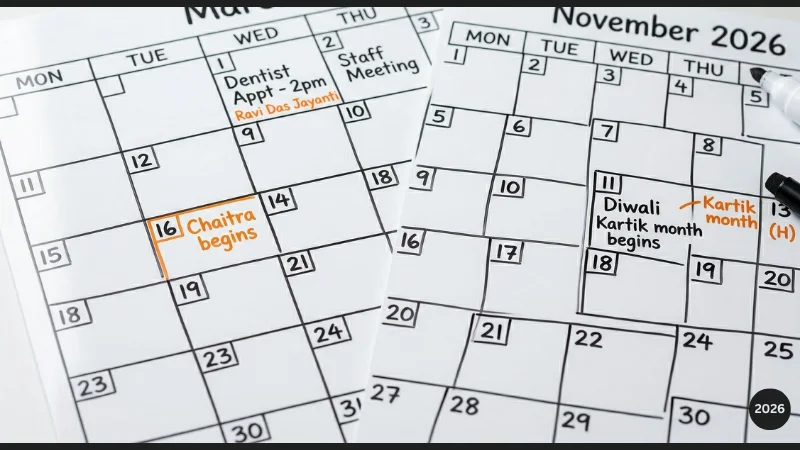
Here is the use case that no whiteboard calendar manufacturer has ever addressed in their product documentation, despite it being directly relevant to millions of households across the US, UK, and Canada.
In Indian diaspora homes, two calendars run simultaneously. The Gregorian calendar governs work deadlines, school schedules, doctor appointments, and anything connected to life in a Western country. The Hindi lunar calendar governs festivals, fasts, auspicious dates for weddings and ceremonies, and the religious rhythm of family life.
A large dry erase wall calendar gives you the physical space to annotate both. Here is the system used by many families, described simply:
Use one colour of dry erase marker — black or dark blue — for all Gregorian entries. Use a second colour — orange or red work well — exclusively for Hindi month transitions and festival dates. When Chaitra begins, mark it in orange in the corner of that date’s cell. When Diwali arrives in Kartik month, the orange marker shows it in its lunar context, not just as a Gregorian date.
In 2026, this dual annotation is especially important because the year contains a 13th Hindi month — Adhik Jyeshtha — running from May 17 to June 15. This extra month shifts almost every festival after May. On a standard printed paper calendar, this anomaly is invisible. On a dry erase yearly wall calendar, it is a marking you add in orange across two weeks in late May and a note that reads: “Adhik Maas — auspicious events pause.”
The complete list of 2026 Hindi month start dates — all 13 of them — is on the monthnameshindi.com Hindi Calendar 2026 page, formatted specifically for manual annotation into any calendar system.
INSTALLATION: THE PART THAT DETERMINES WHETHER THE CALENDAR ACTUALLY GETS USED
A whiteboard calendar that falls off the wall in February is not a planning system. It is a hazard.
For lightweight melamine and acrylic panels under 15 pounds, adhesive mounting strips rated for that weight work reliably on painted drywall. 3M Command strips in the large picture-hanging format hold most standard-size calendar whiteboard panels without drilling.
For porcelain steel panels and glass whiteboards above 15 pounds, stud mounting is required. Use a stud finder before drilling, locate two studs within the intended mounting width of the calendar, and use 2.5-inch wood screws with keyhole or z-clip brackets. Most heavy whiteboard calendars ship with the correct hardware.
For a child’s room or classroom, consider positioning the bottom edge of the calendar at standing eye level for the shortest person who will use it — typically 48 to 52 inches from the floor for children aged 8 to 12.
THE MARKERS: THE PART EVERYONE BUYS WRONG
A dry erase marker from a gas station and a quality dry erase marker are not the same product. The difference shows in three months.
Low-quality markers dry out faster, leave more pigment residue, and are more prone to ghosting on melamine surfaces. Expo brand dry erase markers are the industry standard for a reason — the pigment suspension is formulated specifically for low residue.
For a magnetic dry erase wall calendar used in family spaces, buy a set of fine-tip Expo markers in at least four colours and store them in a magnetic marker tray directly on the whiteboard. Access determines use — if the markers are in a drawer, the calendar stops getting updated within two weeks.
For glass or porcelain surfaces, any quality dry erase marker performs well. The premium surface does the work.
Cultural alignment: AN NRIs REAL STRUGGLE
Choosing a whiteboard calendar isn’t just about office productivity; it’s about cultural alignment. While a printed paper calendar like the Kalnirnay provides the essential data for festivals and Muhurats, its static nature can’t keep up with the fluid changes of a modern household.
By using a whiteboard as your primary display, you gain the “erasable freedom” to map out the 2026 13-month lunar cycle (including Adhik Maas) alongside your digital commitments. It transforms your wall from a simple date-checker into a dynamic tool that respects both the precision of an AI assistant and the traditional wisdom of the Indian calendar.
The choice between having a desk calendar or a wall calendar is also essential for someone seeking cultural alignment at it’s best.
CLOSING: THE WALL THAT THINKS WITH YOU
There is a version of planning that is reactive — you write things down after they’ve been decided, to remember them. And there is a version that is generative — you write things on the wall to see what you’re deciding, to notice where things conflict, to move a block of time the way you’d move furniture in a room you haven’t finished arranging.
A whiteboard calendar enables the second kind. The erasability is not a feature. It is an invitation to think in public — on a surface large enough to see what you actually have and honest enough to let you change your mind.
In 2026, with its 13-month Hindi calendar year, an unusual number of festival dates in flux, and the general complexity of modern household life, a large dry erase wall calendar is arguably the most useful single planning object you can put on a wall. Mark both calendar systems on it. Give each family member a colour. Erase what changes. Keep what matters.
That is what a whiteboard calendar is for.