
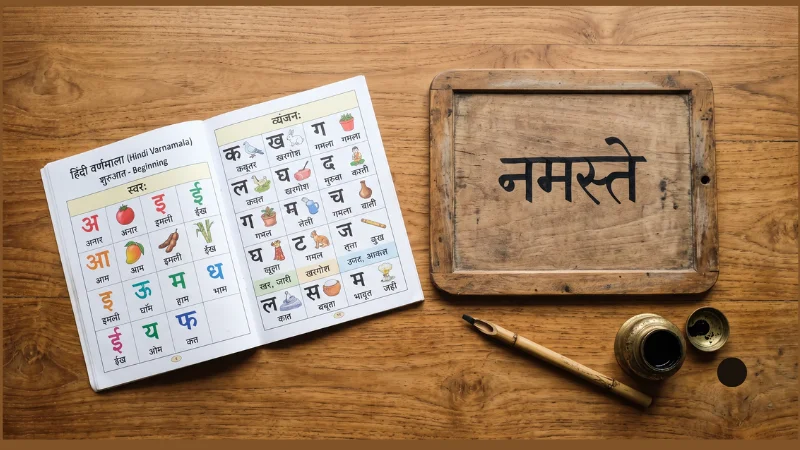
Days of the Week in Hindi: Names &Meanings
Days of the Week in Hindi: Names, Meanings
सप्ताह के दिनों के नाम — हिंदी में
All 7 Hindi weekday names with transliteration, planetary origins, traditional colors, Valentine Week day list, and more — in one complete reference. This sits in close relationship to the month names in Hindi as they play a key role in Indian people lives .
7
Days in a week
रवि
First day (Sun)
शनि
Last day (Saturn)
2000+
Years of Vedic origin
⚡ Direct Answer
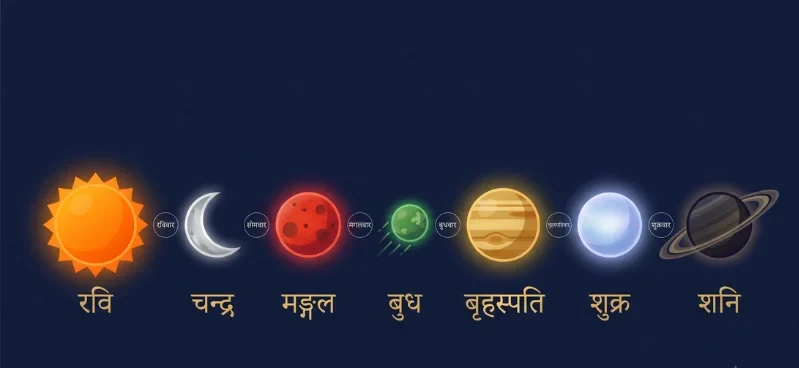
The 7 days of the week in Hindi are: रविवार (Sunday), सोमवार (Monday), मंगलवार (Tuesday), बुधवार (Wednesday), गुरुवार (Thursday), शुक्रवार (Friday), शनिवार (Saturday). Every name ends in “वार” (vaar = day) and begins with the name of a celestial body from Vedic astronomy.
All 7 Days of the Week in Hindi and English
Each hindi week day corresponds to a specific celestial body—from Ravi (Sun) to Shani (Saturn)—dictating its transliteration, cultural significance, and associated auspicious colors. Use this reference guide to easily navigate Hindi day naming conventions and their historical translations.
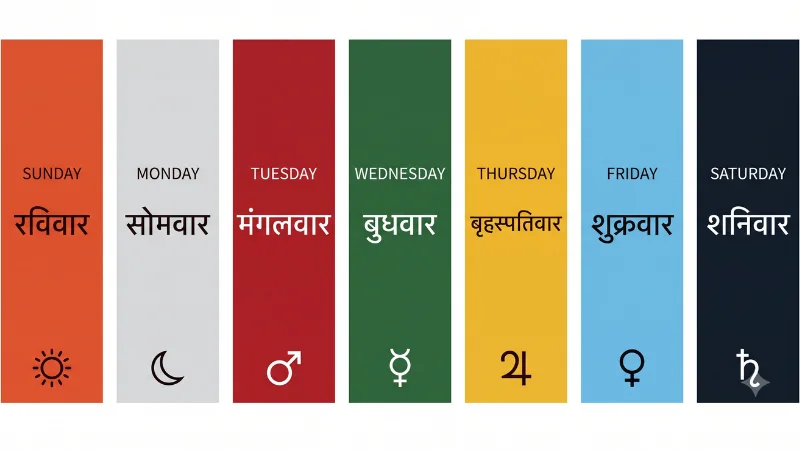
| # | Hindi Name | Transliteration | English | Planet | Color |
|---|---|---|---|---|---|
| 1 | रविवार | Ravivar | Sunday | 🌞 Sun (Ravi) | Red-Orange |
| 2 | सोमवार | Somavar | Monday | 🌙 Moon (Soma) | White / Silver |
| 3 | मंगलवार | Mangalvar | Tuesday | ♂ Mars (Mangal) | Red / Coral |
| 4 | बुधवार | Budhvar | Wednesday | ☿ Mercury (Budh) | Green |
| 5 | गुरुवार | Guruvar | Thursday | ♃ Jupiter (Guru) | Yellow / Gold |
| 6 | शुक्रवार | Shukravar | Friday | ♀ Venus (Shukra) | Light Blue |
| 7 | शनिवार | Shanivar | Saturday | ♄ Saturn (Shani) | Black / Dark |
Each Day of the Week in Hindi — Complete Colored Guide
रवि (Ravi) is the Hindi and Sanskrit name for the Sun. Sunday operates as a universal public holiday in India, with schools, government offices, and most businesses closed for the day.
सोम (Soma) is the Sanskrit word for the Moon. The English word “Monday” shares this exact etymological root, deriving from the Old English “Mōnandæg” (Moon’s day). In modern commercial and institutional frameworks, Somavar marks the commencement of the standard workweek across India and global markets.
मंगल (Mangal) means “Mars” in linguistic and etymological contexts in Hindi. While the English “Tuesday” originates from the Old English designation for the day, the Hindi nomenclature aligns directly with the planetary designation of Mars, the red planet, focusing on action and strength in historical linguistic traditions.
बुध (Budh) is the Hindi and Sanskrit term for the planet Mercury. Etymologically, it shares cross-cultural parallels with the English “Wednesday” (derived from Woden, the Norse god of wisdom). In contemporary Indian commerce, Budhvar is highly notable as the weekly expiry day for several NSE/BSE derivative contracts, serving as a critical mid-week marker for financial markets, traders, and institutional investors.
गुरु (Guru) translates directly to “teacher” in Hindi and Sanskrit linguistic frameworks, while simultaneously serving as the primary designation for the planet Jupiter. In contemporary societal and institutional structures across India, Guruvar is strongly associated with formal education, serving as a traditional day for commencement of academic programs and scholastic investments.
शुक्र (Shukra) translates to “bright” or “brilliant” and serves as the Hindi and Sanskrit designation for the planet Venus. Etymologically, the English word “Friday” shares a cross-cultural parallel, deriving from “Frigg’s day” (the Norse goddess of love), aligning with the Venusian domain. In the context of Indian commerce and retail, Shukravar is historically significant for the gold and jewelry markets, consistently driving higher footfall and luxury market promotions leading into the weekend.
शनि (Shani) is the Hindi and Sanskrit name for the planet Saturn. Etymologically, this represents the most direct link between English and Hindi nomenclature, as “Saturday” literally derives from “Saturn’s day.” Historically, Saturn is recognized in astronomy as the slowest-moving visible planet from Earth, a characteristic that has traditionally defined its perception in various global historical frameworks.
Why Hindi Days Are Named After Planets
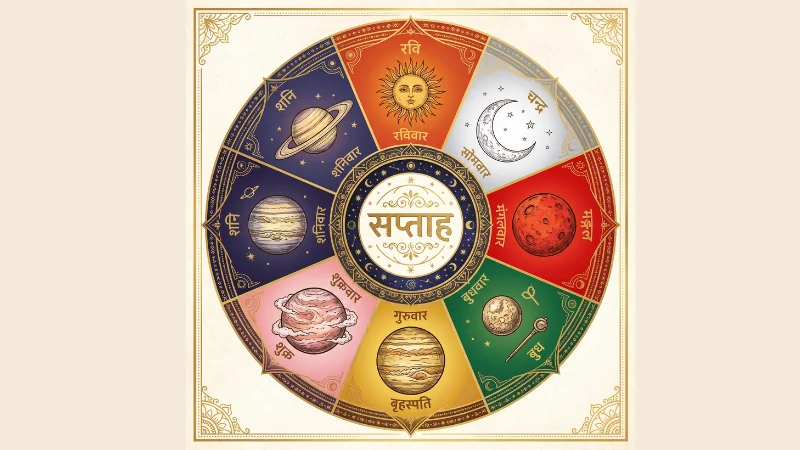
The system of naming days after celestial bodies is based on an ancient astronomical framework. Babylonians identified seven primary celestial bodies visible to the naked eye and assigned each to a specific day. This framework expanded through Greek and Roman history, eventually integrating into the Sanskrit language, which preserves a direct linguistic connection between the celestial body and the day of the week.
The parallel between English and Hindi day naming is rooted in a shared historical adoption of the same ancient astronomical system. English “Saturday” and Hindi “Shanivar” both translate to “Saturn’s Day.” English “Monday” and Hindi “Somavar” both translate to “Moon’s Day.” Hindi names retain direct Sanskrit roots, making the etymological link to these celestial bodies transparent.
Which Day Is First / Last of the Week in India?
Different calendar systems establish different starting points for the week, which can cause variability depending on the framework used.
First Day of Week — India
Many traditional Indian institutional and educational calendars are structured to commence the operational week on Sunday.
Last Day of Week — India
In this organizational model, Saturday serves as the final day, preceding the standard government and school weekly closure periods.
Days of the Week in Other Indian Languages
While India features immense linguistic diversity, major regional languages utilize a shared system of weekday nomenclature based on common astronomical roots. This reflects the historical adoption of a unified celestial tracking method that integrated planetary identifiers across diverse Indian language families, maintaining consistent week-cycle structures nationwide.
Telugu (తెలుగు)
Tamil (தமிழ்)
Kannada (ಕನ್ನಡ)
Marathi (मराठी)
Malayalam (മലയാളം)
Punjabi (ਪੰਜਾਬੀ)
The strong similarity across all Indian languages — especially the shared planetary roots — reflects the unified Vedic astronomical heritage underlying all regional naming traditions.
Weekday Colors in Hindu Tradition
Each day of the week has a traditional color linked to its ruling planet. Many Hindus wear or offer these colors on the corresponding day as a devotional practice.
| Day (Hindi) | Color | Planet | Significance |
|---|---|---|---|
| रविवार (Sunday) | Red / Orange | Sun | Energy, power, the Sun’s fire |
| सोमवार (Monday) | White / Silver | Moon | Purity, coolness, moonlight |
| मंगलवार (Tuesday) | Red / Coral | Mars | Mars appeal, red, courage and action |
| बुधवार (Wednesday) | Green | Mercury | Growth, intellect, commerce |
| गुरुवार (Thursday) | Yellow / Gold | Jupiter | Wisdom, knowledge, abundance |
| शुक्रवार (Friday) | Light Blue | Venus | Beauty, love, material wealth |
| शनिवार (Saturday) | Black / Dark Blue | Saturn | Saturn’s weighty, serious energy |
Which Day Is Best to Buy Gold in India?
Friday (Shukravar) is traditionally considered the most auspicious day for purchasing gold. Venus (Shukra) governs beauty, luxury, and material prosperity—making Friday purchases favorable. Thursday (Guruvar), ruled by Jupiter (planet of expansion and abundance), is the second most favored day. Indian jewelers consistently see higher foot traffic on both days as a result.
Weeks to Days — Quick Reference Table
This table simplifies time tracking for project management and personal planning. It converts standard weekly intervals into daily counts for immediate reference. Use these values to maintain accuracy in deadline scheduling and milestone monitoring.
| Weeks | Days | Weeks | Days | Weeks | Days |
|---|---|---|---|---|---|
| 1 | 7 | 6 | 42 | 13 | 91 |
| 2 | 14 | 7 | 49 | 15 | 105 |
| 3 | 21 | 8 | 56 | 16 | 112 |
| 4 | 28 | 9 | 63 | 20 | 140 |
| 5 | 35 | 10 | 70 | 40 | 280 |
| 12 weeks = 84 days | 3 days = 0.43 weeks | 100 days = 14.3 weeks | |||||
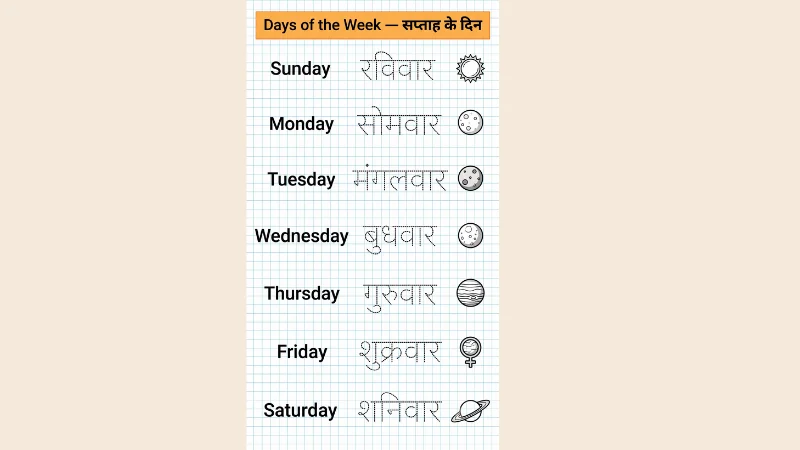
सप्ताह के दिनों के नाम (Days of the Week in Hindi)
This worksheet is designed for structured learning. Use it by having students read aloud the Hindi script and transliteration, then practice writing each name in a notebook to master the spelling and pronunciation associated with the ruling planets.
| # | English | Hindi Script | Transliteration | Planet / Graha |
|---|---|---|---|---|
| 1 | Sunday | रविवार | Ravivar | Sun |
| 2 | Monday | सोमवार | Somvar | Moon |
| 3 | Tuesday | मंगलवार | Mangalvar | Mars |
| 4 | Wednesday | बुधवार | Budhvar | Mercury |
| 5 | Thursday | गुरुवार | Guruvar | Jupiter |
| 6 | Friday | शुक्रवार | Shukravar | Venus |
| 7 | Saturday | शनिवार | Shanivar | Saturn |
Frequently Asked Questions
What are the 7 days of the week in Hindi?
The 7 days in Hindi are: रविवार (Sunday), सोमवार (Monday), मंगलवार (Tuesday), बुधवार (Wednesday), गुरुवार (Thursday), शुक्रवार (Friday), शनिवार (Saturday). Every name ends in “वार” (vaar), meaning day.
How many days are in a week?
There are 7 days in a week. This is universal across all major calendar systems — Gregorian, Hindu, Islamic, and Jewish. The 7-day week originated in Babylonian astronomy, which identified 7 celestial bodies visible to the naked eye and named one day after each.
Which is the first day of the week in India?
In India, Sunday (रविवार) is the first day of the week. Indian printed calendars, school timetables, and the Hindu Panchang all begin the week with Sunday. The ISO 8601 international standard places Monday first, but this is not the Indian convention.
Which is the last day of the week?
Saturday (शनिवार) is the last day of the week in the Indian calendar system, since the week begins with Sunday. This matches most Indian printed calendars, which show Saturday in the final column.
Which is the second day of the week?
In the Indian calendar system (starting with Sunday), Monday (सोमवार) is the second day of the week. In the ISO system (starting with Monday), Tuesday would be second. Most Indian calendars use Sunday as day one, so Monday is the second day.
Why are Hindi weekday names different from English?
They’re actually built on the same system — just different languages. Both Hindi and English day names come from the 7 celestial bodies of ancient Babylonian astronomy. Hindi uses Sanskrit planet names (Ravi for Sun, Soma for Moon, etc.) while English uses Norse and Latin equivalents. Saturday in English = Shanivar in Hindi: both mean Saturn’s day.
What day of the week was 15 August 1947?
India’s Independence Day, August 15, 1947, fell on a Friday — शुक्रवार (Shukravar). Friday is considered auspicious in Hindu tradition, as Venus (Shukra) governs prosperity and new beginnings.
How many days is 6 weeks?
6 weeks = 42 days (6 × 7 = 42). To convert any number of weeks to days, multiply by 7. This is useful for pregnancy tracking (40 weeks = 280 days), project timelines, and school terms.
Why is a week 7 days?
The 7-day week originated in ancient Babylon, where astronomers identified exactly 7 celestial bodies visible to the naked eye: the Sun, Moon, Mars, Mercury, Jupiter, Venus, and Saturn. Each was assigned to one “day.” This system spread through Greece, Rome, and India, where it merged with Vedic planetary lore. The number 7 has no deep astronomical necessity — it’s a cultural artifact that became universally adopted.