
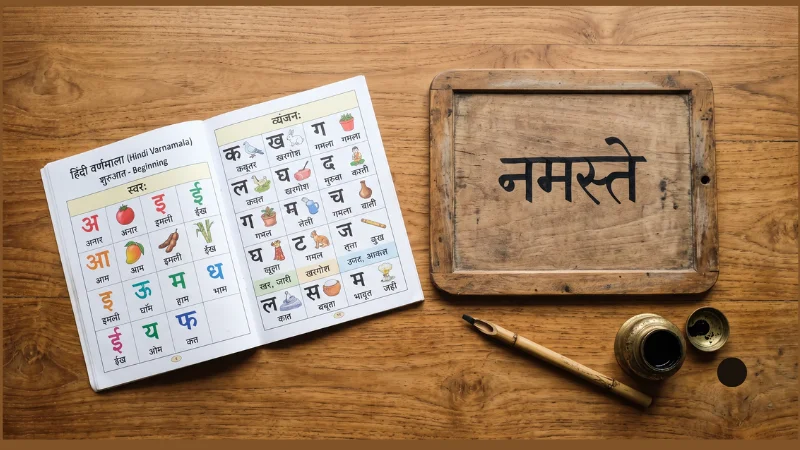
How to Learn Hindi: A Complete Roadmap for Adult Beginners
How to Learn Hindi: A Complete Roadmap for Adult Beginners
हिंदी सीखें
An honest answer to “is Hindi hard to learn,” a realistic timeline, and the five-stage roadmap that actually gets you speaking — not just memorizing.
Cat III
FSI difficulty rank
~1,100
Est. class hours
2–4 wks
To read Devanagari
SOV
Word order (not SVO)

⚡ Direct Answer
Hindi is moderately difficult for English speakers — harder than Spanish or French, but easier than Arabic, Mandarin, or Japanese. The U.S. Foreign Service Institute places it in Category III (~1,100 class hours to reach professional proficiency). The script looks intimidating but is phonetic and learnable in a few weeks. The real challenge is grammar — word order, gender agreement, and sounds that don’t exist in English.
Is Hindi Hard to Learn? What the Data Actually Says
The U.S. Foreign Service Institute (FSI) — which trains American diplomats and has decades of data on how long different languages take English speakers to learn — sorts languages into four difficulty categories. Hindi sits in Category III, alongside Russian, Greek, Thai, and Vietnamese.
That’s genuinely useful context: Hindi isn’t in the “easy” bracket with Spanish or Italian, but it’s nowhere near Category IV, where Arabic, Mandarin, Japanese, and Korean live. If you’ve been dreading Hindi because you assumed it belonged in that hardest tier, it doesn’t.
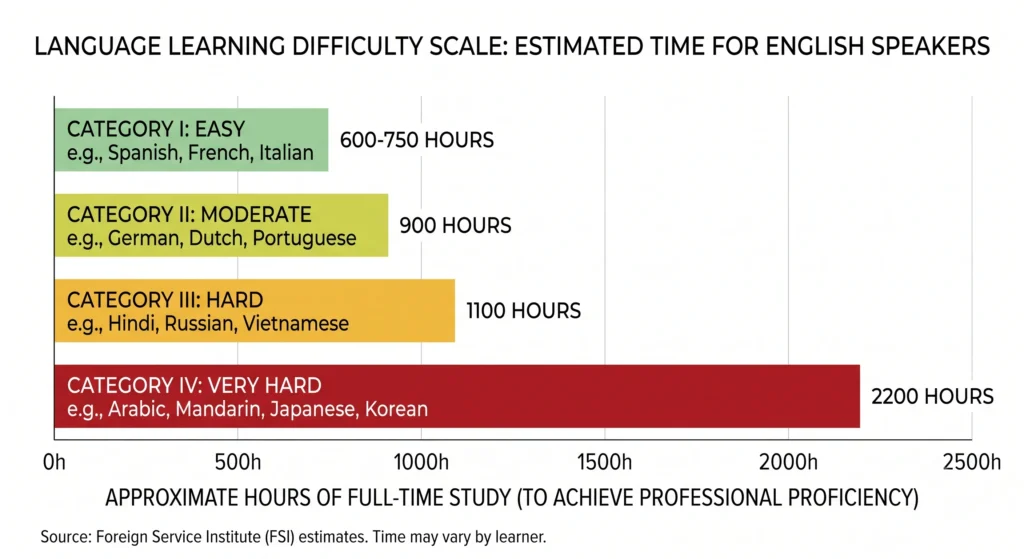
Source: U.S. Foreign Service Institute language difficulty rankings. Figures reflect full-time classroom instruction; self-paced learning will vary.
How Long Does It Actually Take to Learn Hindi?
The FSI’s 1,100-hour estimate assumes 25 hours a week of intensive classroom study — not realistic for most adult learners fitting Hindi around a job or family. Here’s what that looks like at more typical paces.
| Study Pace | Time to Basic Conversation | Time to Comfortable Fluency |
|---|---|---|
| 30 min/day | 4–6 months | 3–4 years |
| 1 hour/day | 2–3 months | 18–24 months |
| 2+ hours/day + immersion | 6–8 weeks | 9–12 months |
“Basic conversation” vs. “fluency”
Basic conversation means ordering food, small talk, and simple exchanges. Comfortable fluency means following a movie without subtitles or holding an unscripted conversation with a native speaker at normal speed. Most learners get real, useful value long before they hit the fluency mark — don’t wait for “perfect” to start using it.
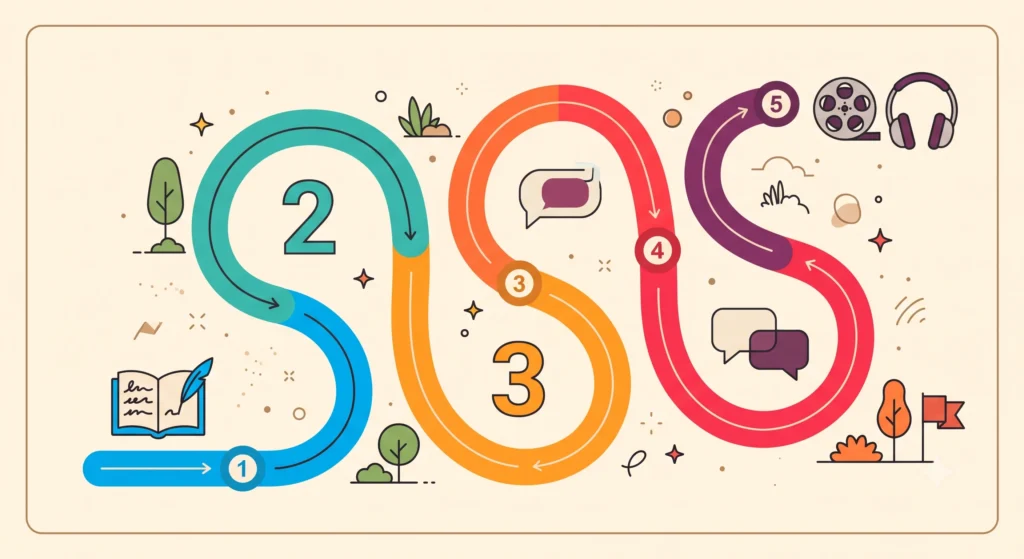
The 5-Stage Roadmap: What to Actually Learn, in Order
Most people fail at learning Hindi not because it’s too hard, but because they learn things in the wrong order — memorizing vocabulary lists before they can even read the script. Here’s the sequence that works.
- 1 Weeks 1–2
Devanagari Script Foundation
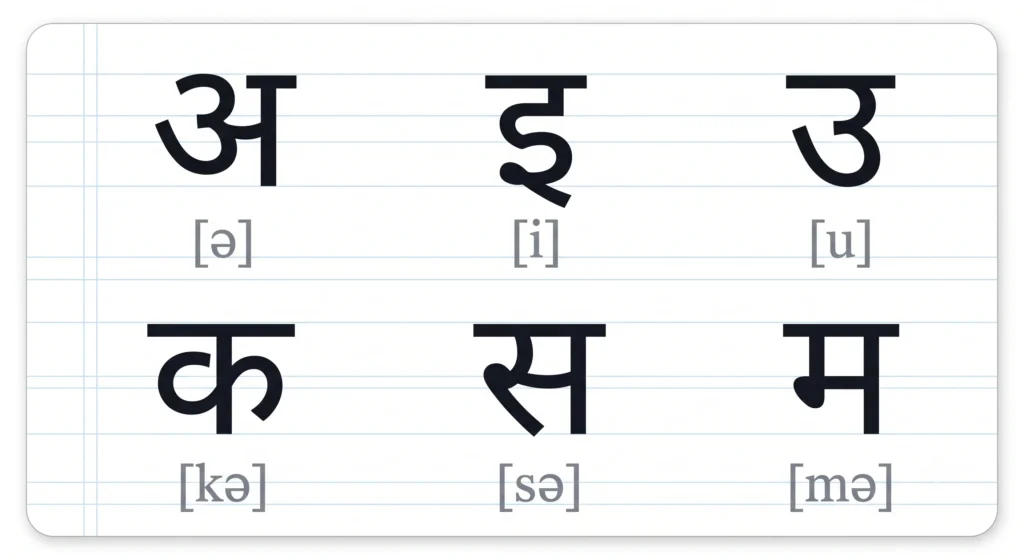
Before anything else, learn to read. Devanagari is phonetic — once you know a symbol’s sound, you can read it correctly every time, unlike English spelling. Master the vowels and consonants first; conjuncts come later.
→ Full Hindi Alphabet Guide - 2 Weeks 3–4
Numbers & Counting
Numbers overlap heavily with the script you just learned and get used constantly — prices, dates, phone numbers, ages. Learning them early gives you daily practice reps without needing full sentences yet.
→ Complete Hindi Numbers Guide - 3 Month 2
Core Grammar & Sentence Structure
This is where Hindi actually gets different from English: subject-object-verb order, gendered nouns, and verb agreement. Don’t skip this stage to jump to vocabulary — grammar rules learned early make learning far faster.
- 4 Months 3–4
Everyday Vocabulary & Conversation
Greetings, family terms, food, directions, formality levels (tu, tum, aap). Practice out loud from day one at this stage — passive vocabulary that you can’t produce in speech doesn’t count as learned.
- 5 Months 5+
Immersion & Fluency Building
Bollywood films with Hindi subtitles, music, news, and — most valuable of all — actual conversation partners. This is the slow, unglamorous stage where fluency is genuinely built.
What’s Actually Easier Than You Think — and What Isn’t
Easier Than Expected
- The script is phonetic. Once you learn a Devanagari symbol’s sound, it’s consistent — no silent letters, no “ough” problems.
- You already know Hindi words. English borrowed jungle, shampoo, loot, thug, bungalow, guru, karma, yoga, mantra, avatar, pajamas, veranda, khaki, dusky, bandana, chutney, and juggernaut — all from Hindi/Hindustani or Sanskrit.
- Massive free content exists. Bollywood, Hindi YouTube, and news give you more native-speaker immersion materials than almost any other non-European language.
- Loanwords go both ways. Everyday spoken Hindi uses English words directly — school, table, computer, mobile — so your existing vocabulary already overlaps more than you’d guess.
The Real Challenges
- Word order flips. Hindi is Subject-Object-Verb (“I book read”), not English’s Subject-Verb-Object. This rewrites how you build sentences.
- Nouns have gender. “Good boy” (अच्छा लड़का) and “good girl” (अच्छी लड़की) use different adjective endings — and this applies to verb agreement too.
- Formality levels multiply ‘you’. तू (tu), तुम (tum), and आप (aap) are all “you”, but picking the wrong one for the situation is a genuine social misstep.
- New sounds exist. Hindi distinguishes aspirated from unaspirated consonants (ph vs p) and retroflex from dental sounds — pairs that sound identical to an untrained English-speaking ear at first.

everyday items including pajamas, shampoo, a bungalow, and a veranda, representing common English loanwords derived from Hindi.Best Ways to Learn Hindi — Honestly Compared
Choosing the right language learning strategy requires balancing structured study with real-world practice to avoid common progress plateaus. The comparative breakdown below evaluates the most popular methods, mapping their core strengths against their inherent limitations. Use this structured analysis to design a highly personalized, multi-channel curriculum that accelerates your path to fluency.
| Method | Best For | Weak Point |
|---|---|---|
| Structured Apps (Duolingo, Mondly, etc.) | Daily habit-building, core vocabulary, low commitment | Doesn’t build real conversational speed |
| Formal Classes (Tutors, community classes) | Grammar structure, live correction, accountability | Cost and scheduling commitment |
| Immersion Media (Bollywood, music, YouTube) | Listening comprehension, culture, motivation, retention | Unstructured — easy to plateau without active study alongside it |
| Conversation Exchange (Language partners, HelloTalk style) | Speaking confidence, real-world usage, formality practice | Requires finding and keeping a consistent partner |
| Textbooks / Self-Study | Systematic grammar coverage at your own pace | Can feel dry without a speaking outlet alongside it |
No single method gets you there alone. Learners who reach comfortable fluency fastest typically combine a structured app or class for grammar with immersion media for listening and a conversation partner for speaking — not one tool doing all three jobs.
Learning Hindi Through Your Mother Tongue
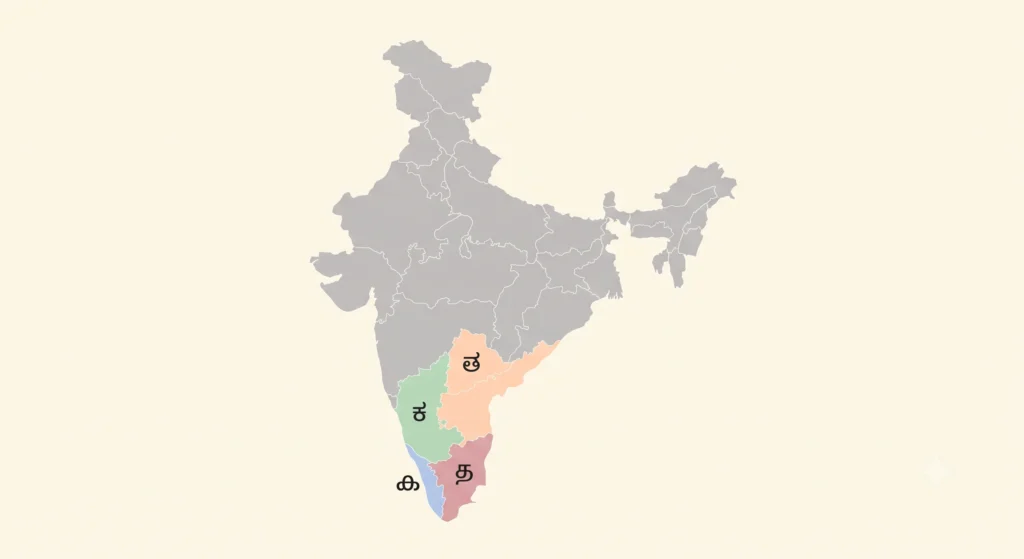
If your first language is Tamil, Telugu, Kannada, or Malayalam, you’re not starting from zero the way an English-only speaker is. Sanskrit has shaped vocabulary across Dravidian languages for centuries through religious, literary, and administrative contact — so more words feel familiar than you’d expect, even before you’ve studied a single Hindi lesson.
Dedicated guides for learning Hindi through each of these languages are in progress. Here’s what each will cover:
தமிழ் → हिंदी
learn Hindi through TamilShared Sanskrit-derived vocabulary, grammar contrasts, and a phased lesson path built specifically for Tamil speakers.
తెలుగు → हिंदी
learn Hindi through TeluguScript comparison, common cognates, and pronunciation notes tailored to Telugu speakers’ existing sound system.
ಕನ್ನಡ → हिंदी
learn Hindi through KannadaGrammar parallels, everyday vocabulary crossover, and a structured beginner path for Kannada speakers.
മലയാളം → हिंदी
learn Hindi through MalayalamSound system comparison and a beginner reading path that builds on Malayalam speakers’ existing Sanskrit vocabulary base.
Where Is Hindi Spoken? Who Actually Speaks It?
Hindi is spoken by several hundred million people as a first or second language, making it one of the most-spoken languages in the world. It’s the primary language across most of North and Central India — Uttar Pradesh, Bihar, Madhya Pradesh, Rajasthan, Haryana, Delhi, Jharkhand, Chhattisgarh, Uttarakhand, and Himachal Pradesh — and functions as a widely understood link language across much of the rest of the country.
It’s not universal, though. South Indian states like Tamil Nadu, Kerala, Karnataka, and Andhra Pradesh have their own primary languages, and not everyone there speaks Hindi fluently — a common misconception among people outside India. Beyond India, Hindi (or closely related Hindustani) has significant speaker communities in Nepal, Fiji, Mauritius, Trinidad, Guyana, Suriname, and diaspora populations across the UK, US, and Canada.
Learning Hindi as a Diaspora Adult
A significant number of Hindi learners aren’t beginners in the usual sense — they’re second- or third-generation diaspora Indians who grew up hearing Hindi at home without ever formally learning to read or speak it fluently. If that’s you, you have a genuine head start: your ear is already tuned to Hindi’s rhythm and sounds, even if your active vocabulary is small.
It’s also worth knowing you’re not alone in learning Hindi as an adult with no childhood exposure at all. Actress Katrina Kaif, who grew up primarily English-speaking, learned Hindi for her Bollywood career. Nora Fatehi, born in Canada to Moroccan parents, learned it the same way. Sonia Gandhi, Italian-born, learned Hindi after marrying into Indian public life. Adult fluency is genuinely achievable — it just takes the right exposure and consistency.
Frequently Asked Questions
The most common questions about learning hindi — answered directly.
Is Hindi hard to learn for English speakers?
Moderately hard. The U.S. Foreign Service Institute places Hindi in Category III (~1,100 class hours) — harder than Spanish or French, but significantly easier than Arabic, Mandarin, Japanese, or Korean.
How long does it take to learn Hindi?
At 1 hour of daily study, expect basic conversation in 2–3 months and comfortable fluency in 18–24 months. Pace varies widely based on immersion access and prior language-learning experience.
Can I learn Hindi on Duolingo?
Duolingo is a solid tool for building daily habit and core vocabulary, but it doesn’t build real conversational speed on its own. Pair it with immersion media and, ideally, a conversation partner.
What is the best way to learn Hindi?
No single method works alone. The fastest results come from combining a structured app or class (grammar), immersion media like Bollywood or Hindi YouTube (listening), and a conversation partner (speaking).
Do all Indians speak Hindi?
No. Hindi is dominant across North and Central India and widely understood as a link language, but South Indian states like Tamil Nadu, Kerala, and Karnataka primarily use their own languages, and not everyone there speaks Hindi fluently.
Is Hindi easier for Tamil or Telugu speakers to learn?
Often somewhat, yes. Sanskrit has influenced vocabulary across Dravidian languages for centuries, so Tamil, Telugu, Kannada, and Malayalam speakers frequently recognize more Hindi vocabulary than English-only speakers do, even before formal study.
How long does it take to learn the Hindi alphabet?
Most learners can read basic Devanagari — vowels and consonants — within 2 to 4 weeks of consistent practice, since the script is phonetic rather than requiring memorized spelling rules.
Can adults really become fluent in Hindi with no childhood exposure?
Yes. Public figures like Katrina Kaif, Nora Fatehi, and Sonia Gandhi all learned Hindi as adults with no childhood exposure to the language and reached genuine fluency.