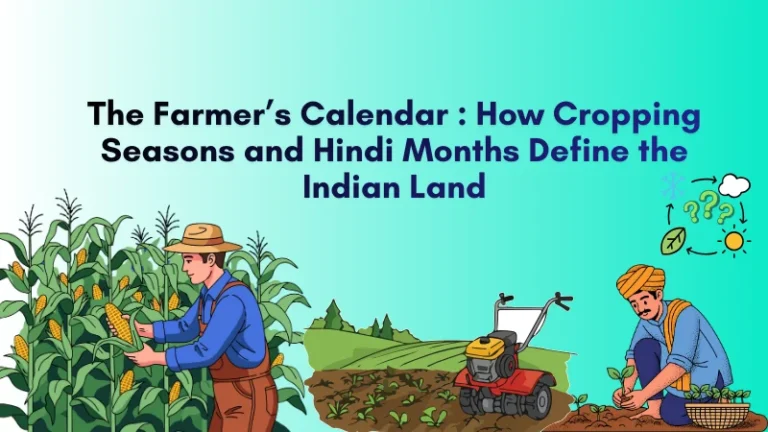

Indian Rabi crops sown in Winter season
Rabi crops are winter-season crops sown in October–November, after the monsoon retreats, and harvested in March–April when spring arrives.
There is a particular kind of quiet that settles over north India in October.
The monsoon has packed up and left. The soil — drenched and steaming for four months — finally firms up. The air loses its weight. And somewhere on the outskirts of Ludhiana, a farmer climbs onto a tractor before sunrise, turns the first furrow of cool earth, and begins again.
This is how India’s rabi crop season starts. Not with a fanfare. With a tractor engine and the smell of cold soil in the Kartika morning.
For Indians living in the US, the rabi season carries a particular kind of memory. It is the smell of mustard fields in February when you visit India in winter. It is the image of golden wheat stretching to the horizon in March, weeks before Baisakhi. It is your grandmother making fresh methi ki sabzi from the kitchen garden in December — because rabi vegetables are always best eaten where they grow. This guide is for anyone who wants to understand rabi crops — not just as a definition, but as the living, breathing backbone of India’s food supply and cultural calendar.
What Are Rabi Crops?
The word rabi comes from Arabic, meaning spring — these are the crops that are ready in spring, not when they are sown. They grow slowly and quietly through India’s coolest months and emerge ready for harvest just as temperatures begin to rise. In India’s traditional six-season Ritu calendar, rabi crops grow entirely within Hemanta Ritu (Margashirsha–Pausha, November–January) and Shishira Ritu (Magha–Phalguna, January–March). Their harvest aligns with the first warmth of Vasanta Ritu — spring arriving to collect what winter nurtured.
What defines a rabi crop is not just timing. It is water. Unlike kharif crops, which drink the monsoon directly, rabi crops rely on stored soil moisture — the water the monsoon soaked into the ground through September — supplemented by canal irrigation and tube wells. The monsoon charges the soil. The rabi season spends it.
Rabi Season Months: The Complete Calendar
The rabi season is longer than the kharif window — six months from sowing to harvest — because winter growth is deliberately slow. Cool temperatures conserve moisture, reduce pest pressure, and allow grain to develop density that heat-season crops cannot match.
| Phase | Gregorian Months | Hindi Calendar Months | What’s Happening |
|---|---|---|---|
| Land preparation | September – October | Ashwin – Kartika | Kharif harvest done, soil tilled |
| Sowing | October – November | Kartika – Margashirsha | Seeds into cool, moist earth |
| Growing season | November – February | Margashirsha – Magha | Slow winter growth, light irrigation |
| Grain filling | February – March | Phalguna – Chaitra | Critical moisture stage for wheat |
| Harvest | March – April | Chaitra – Vaisakha | Mechanical harvesting begins |
The rabi crops months are a study in patience. Wheat sown in early November will not be harvested until late March — nearly five months underground, growing through Diwali, through Christmas, through Lohri, through the fog of a Punjab winter, emerging golden just as the Baisakhi drums begin.
Miss the sowing window — delay wheat planting past mid-November — and yields drop by roughly 1% per day. The rabi season does not negotiate.
Rabi Crops List: What India Grows in Its Coolest Months
Wheat: The Crop That Changed India’s History
Wheat is the most important rabi crop in India — and one of the most consequential agricultural stories of the 20th century.
India is the world’s second-largest wheat producer, with Punjab, Haryana, Uttar Pradesh, Madhya Pradesh, and Rajasthan together accounting for over 90% of production. Total wheat output reached a record 112.74 million tonnes in 2022-23 according to the Ministry of Agriculture, a number that would have been unimaginable in 1960 when India was rationing grain from American food aid ships.
The transformation happened through the Green Revolution of the 1960s — a rabi revolution at its core. When agricultural scientist M.S. Swaminathan introduced Norman Borlaug’s high-yielding dwarf wheat varieties to Punjab and Haryana, the rabi season became the engine of India’s food security. Fields that yielded 800 kg per hectare began producing 4,000 kg. India went from importing wheat to exporting it within a decade.
Wheat needs cool temperatures of 10–15°C at sowing and around 21–26°C at ripening. It cannot tolerate waterlogging, frost damage at grain-filling stage, or the heat of summer. The rabi season’s cool, dry months are precisely the conditions wheat was bred to exploit.
Mustard: The Yellow That Paints February in Punjab
If you have ever flown into Delhi in February and seen the landscape from the window, you have seen it — those impossibly vivid yellow fields stretching across the Indo-Gangetic plains like someone spilled sunlight on the earth.
That is mustard. India’s most important rabi oilseed and one of its most visually arresting crops.
Rajasthan alone produces over 45% of India’s total mustard output, making it the dominant rabi oilseed state by a wide margin. Haryana, Uttar Pradesh, and Madhya Pradesh follow. Mustard is sown in October and harvested in February–March — a relatively short window compared to wheat, which makes it an excellent rotation crop for farmers who want to free land for early summer vegetables.
India is the world’s fourth-largest mustard producer. Most of it becomes edible oil. The rest stays in Indian kitchens as the sharp-smelling oil that gives Bengali food its particular heat and Rajasthani curries their earthiness.
For NRI families in the US, mustard oil is often the cooking ingredient most associated with “tasting like home.” That taste is a rabi crop. It grew in winter. It was pressed in March. It crossed an ocean to sit on your shelf in New Jersey.
Gram (Chickpea): India’s Most Important Rabi Pulse
India is the world’s largest chickpea producer. Nearly all of it is a rabi crop.
Gram — the chana of every chana masala, the chickpea of every hummus jar, the kabuli of every North Indian wedding banquet — grows through the cool months in Madhya Pradesh, Rajasthan, Maharashtra, and Uttar Pradesh. Both desi varieties (dark, rough-coated, smaller) and kabuli varieties (pale, large, smooth-coated) are grown as rabi crops.
Chickpea thrives in the rabi season because it is a cool-season legume that fixes atmospheric nitrogen into the soil — making it not just a food crop but a soil health crop. Farmers who grow wheat and gram in rotation consistently report better wheat yields in subsequent seasons because gram leaves the soil nitrogen-richer.
Barley: The Ancient Rabi Grain That Predates Wheat
Barley is one of India’s oldest cultivated crops and a reliable rabi staple. It is hardier than wheat, more drought-tolerant, and grows well in saline and alkaline soils where wheat struggles. Rajasthan and Uttar Pradesh lead production.
Most Indians encounter barley as jau — used in traditional winter health drinks, sattu preparations, and increasingly as a component of multigrain flour. Globally, India’s barley is in demand for malt production in the brewing industry.
Masoor (Red Lentil): The Rabi Pulse in Every Pantry
Masoor dal — the red lentils that cook quickly into silky, orange-red dal — is a rabi pulse grown primarily in Uttar Pradesh, Madhya Pradesh, and Bihar. Cold-tolerant and low-water, masoor is among the most efficient food crops in India’s rabi portfolio.
India is both a major producer and consumer of masoor. Most households in north and central India consume masoor dal at least twice weekly. It is the rabi season, quietly, that keeps that daily bowl filled.
Rabi Vegetables: India’s Winter Kitchen Garden
The rabi season produces India’s most diverse and nutritious vegetable window. If you have lived in north India or visited family there in December–February, you know this abundance viscerally.
Peas flood Indian markets from January to March — the Margashirsha–Magha window — peaking in February when the pods are sweetest and freshest. Potato, India’s most consumed vegetable, is a rabi crop with Uttar Pradesh, West Bengal, and Bihar leading output.
Onion, cauliflower, cabbage, carrot, spinach, fenugreek (methi), coriander, and radish are all rabi vegetables, harvested through the winter months. The methi paratha of January, the gajar ka halwa of December, the matar paneer of February — all rabi-season dishes, whether the recipe specifies it or not.
Rabi Crops Across India: State-by-State
| Crop | Leading States |
|---|---|
| Wheat | Punjab, Haryana, UP, MP, Rajasthan |
| Mustard | Rajasthan, UP, Haryana, MP |
| Gram (Chickpea) | MP, Rajasthan, Maharashtra, UP |
| Barley | UP, Rajasthan, Haryana |
| Masoor (Lentil) | UP, MP, Bihar |
| Peas | UP, Punjab, Himachal Pradesh |
| Potato | UP, West Bengal, Bihar |
Why the Rabi Harvest Is One of India’s Most Significant Economic Events
The rabi season contributes approximately 50–55% of India’s total food grain production. That single statistic explains why the Indian government monitors rabi sowing progress every November with the same attention it gives to the monsoon forecast every June.
The Minimum Support Price (MSP) for wheat — set by the Cabinet Committee on Economic Affairs each October, just as rabi sowing begins — is one of India’s most politically consequential economic decisions. It determines what Punjab and Haryana farmers will earn for their harvest and, by extension, how much wheat the Food Corporation of India can procure for the public distribution system. The MSP for wheat in 2024-25 was set at ₹2,275 per quintal — a 7% increase, reflecting the government’s recognition that rabi wheat underpins national food security.
When rabi wheat procurement is strong, India’s food buffer stocks are full. When a late frost hits Punjab in February — the grain-filling stage, the most vulnerable moment — wheat yields drop and flour prices follow nationwide.
Rabi Crops and the Festival Calendar: Lohri, Makar Sankranti, Baisakhi
Here is the connection most agricultural guides miss entirely: the rabi season and India’s winter festivals are the same story told twice.
Lohri, celebrated on January 13 in Punjab and Haryana, marks the midpoint of winter — the point when rabi crops are established and farmers can feel the season turning toward harvest. The bonfire, the rewri, the til laddoo — all winter foods made possible by rabi oilseeds and sesame.
Makar Sankranti on January 14 marks the sun’s northward journey — the astronomical signal that days are lengthening, warmth is returning, and the rabi harvest is six weeks away. In every form it takes — Pongal in Tamil Nadu, Uttarayan in Gujarat, Khichdi in UP — it is a harvest anticipation festival.
And then Baisakhi in mid-April — the rabi harvest celebration itself. The wheat is cut. The threshing is done. The granaries are full. Bhangra is not a performance at Baisakhi; it is the sound of physical relief, the body celebrating that the gamble paid off again.
For Punjabi and Haryanvi families in the US, Baisakhi events in April — in Fremont, in Jersey City, in Chicago — carry an agricultural memory that most second-generation attendees don’t consciously register. But it is there. The dhol beat that makes you move is the same beat that marked the end of a rabi season for your grandparents.
Frequently Asked Questions about Rabi crops
What are rabi crops in simple terms? Rabi crops are winter-season crops sown in October–November after India’s monsoon ends and harvested in March–April when spring arrives. They grow in cool, dry conditions using stored soil moisture and irrigation. Wheat, mustard, gram, barley, and lentils are the most important rabi crops.
What are the rabi crop season months in India? Sowing begins October–November (Kartika–Margashirsha in the Hindi calendar), growing continues through December–February (Pausha–Phalguna), and harvesting happens in March–April (Chaitra–Vaisakha). The full rabi season spans approximately six months.
Is wheat a rabi or kharif crop? Wheat is a rabi crop — sown in November in cool temperatures and harvested in March–April. It cannot survive the heat, humidity, and waterlogging of the monsoon kharif season. India’s wheat belt — Punjab, Haryana, UP — is defined by its rabi sowing conditions.
What are the main rabi pulses? The major rabi pulses are gram (chickpea), masoor (red lentil), and peas. India is the world’s largest chickpea producer, and almost all gram cultivation happens in the rabi season. Masoor is grown primarily in UP, MP, and Bihar.
Which crops are grown in the winter season in India? The main winter season crops are wheat, barley, mustard, gram, masoor, peas, potato, onion, cauliflower, fenugreek (methi), spinach, coriander, and carrot. These are all rabi crops, sown October–November and harvested through March–April.
Is mustard a rabi crop? Yes. Mustard is India’s most important rabi oilseed. Rajasthan produces nearly half of India’s total mustard output. It is sown in October and harvested in February–March — the season responsible for the yellow mustard fields that define north India’s February landscape.
Why are rabi crops less risky than kharif crops? Rabi crops do not depend on the unpredictable monsoon. They use stored soil moisture and managed irrigation, giving farmers more control over water supply. However, rabi crops face their own risks — unexpected frost in February can devastate wheat at the grain-filling stage, and rising input costs for irrigation have become a growing challenge.
Do NRI families in the US celebrate any rabi season festivals? Yes — more than most realize. Lohri, Makar Sankranti, and Baisakhi are all rabi-season festivals. Lohri marks mid-winter, Makar Sankranti marks the turn toward harvest, and Baisakhi celebrates the rabi wheat harvest itself. NRI communities across the US — particularly Punjabi communities in the Bay Area and Greater New York — celebrate all three, carrying the agricultural calendar of north India into their American winters and springs.
What is the MSP for rabi crops and why does it matter? The Minimum Support Price is the guaranteed price at which the Indian government procures rabi crops from farmers. For 2024-25, wheat MSP was set at ₹2,275 per quintal. The MSP ensures farmers are not left to the mercy of market price crashes — it is the financial floor beneath India’s rabi season and directly affects whether farmers choose to plant in October or switch to other crops.
The Season That Asks Nothing but Patience
There is something deeply unhurried about rabi farming that sets it apart from the monsoon urgency of the kharif season.
When a kharif farmer plants rice, they are racing the monsoon — sowing before the rain stops, harvesting before the cold arrives. Every day carries weather risk. The kharif season is dramatic. It is India holding its breath.
The rabi season is different. The wheat farmer in Haryana sows in November and then waits. Five months of cool mornings, light irrigation, fog across the fields, the crop growing so slowly you cannot see it day to day — and then suddenly, March arrives and the fields are gold from horizon to horizon.
For the Indian diaspora in the US, understanding rabi crops means understanding a particular kind of rural Indian patience — one that is woven into the DNA of north Indian farming families. The methi in your paratha, the besan in your kadhi, the wheat in your roti — all of it asked someone in Punjab or Rajasthan to plant in November and trust that spring would come.
It always does.