
CLOSING: THE WALL THAT CAN HOLD A WHOLE YEAR
There is a version of planning that is cramped, abbreviated, and perpetually inadequate to the life it’s trying to contain. The phone calendar entry that says “D — appt” because there wasn’t space for more. The desk calendar cell with three overlapping scrawls in three different directions. The wall calendar consulted reluctantly because it requires squinting to be legible.
A huge wall calendar is the alternative to all of that. It is the decision to give your time the physical space it deserves — to say that what you’re planning matters enough to be displayed at full scale, in readable handwriting, with enough room that two calendar systems and four family members can coexist on the same surface without any of them disappearing into a corner.
In 2026, with its thirteen Hindi months, its shifted festival dates, and its particular demand on families who live at the intersection of two calendars, the large format wall calendar is not a luxury. It’s the surface that makes the year legible. Put a big one up. Use both colours. Stop squinting at time.
THE BEST HUGE WALL CALENDAR FOR 2026: SIZE GUIDE & FORMATS TO CHOOSE
A huge wall calendar is not a vanity purchase. It’s a spatial argument — an insistence that your time deserves to be seen at full scale rather than compressed into a phone screen or abbreviated into a two-inch cell that holds three words and a squinted question mark.
When a calendar is large enough to read from across a room, something changes in how a household relates to it. The week becomes visible before you’ve had coffee. The month’s shape — dense in the middle, looser at the edges — registers in peripheral vision. The family gathering in the kitchen has a shared surface of information that doesn’t require anyone to unlock a device or call across the house.
For most years, this is a practical argument about preference. For 2026, it becomes a structural necessity for any household that tracks both a Gregorian calendar and the Hindi lunar calendar — because 2026 has thirteen months, not twelve, and fitting thirteen months on a standard-size calendar is an exercise in illegibility that resolves only one way: you need more wall.

WHY 2026 SPECIFICALLY DEMANDS A LARGE WALL CALENDAR
Let’s start there, because it changes the rest of the conversation.
The Hindi lunisolar calendar — theVikram Samvat system followed by hundreds of millions of people across India and the global Indian diaspora — inserts an intercalary month called Adhik Maas approximately every 2.5 to 3 years.
In 2026, this extra month is Adhik Jyeshtha, running from May 17 to June 15. Its purpose is astronomical: without it, the lunar year’s 354 days would drift progressively away from the solar year’s 365, shifting festival dates through seasons over decades until Holi fell in monsoon and Diwali in summer.
The addition of Adhik Jyeshtha means the Hindi calendar in 2026 has thirteen months — not metaphorically, but literally. A household tracking both systems needs physical space to display thirteen Hindi month transitions alongside twelve Gregorian months.
On a standard 17×11 inch desk calendar or a compact 20×15 inch wall calendar, this means the annotation for Hindi months competes illegibly with Gregorian entries.
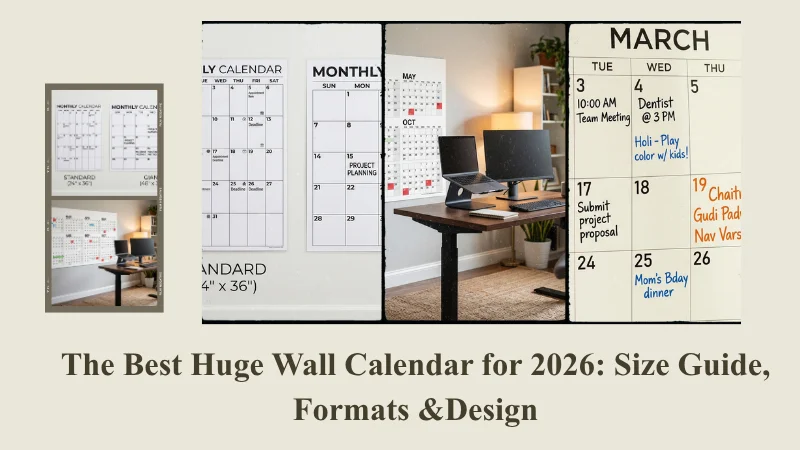
On a 36×24 inch large wall calendar, each day cell expands to approximately 2.5 x 2.5 inches — enough for a primary entry in one colour and a secondary notation in another.
On a 48×36 inch format, each cell is closer to 3.5 x 3.5 inches, which gives a family with four schedules plus Hindi month annotations room to breathe. The 13-month Hindi year of 2026 is, practically speaking, a size argument.
The complete list of all thirteen 2026 Hindi month start dates — formatted for annotation into any wall calendar format — is on the monthnameshindi.com Hindi Calendar 2026 page. Mark them in a second colour from day one. The rest of the year’s planning gets significantly simpler.

HOW LARGE IS LARGE? A PRECISE SIZE GUIDE
The phrase “large wall calendar” covers an enormous range in the market — from a modest 20×28 inch poster calendar to a genuine 60×36 inch command centre installation. Knowing which size solves which problem prevents the most common large calendar mistake: buying something that photographs large and measures inadequate.
Standard Large: 24×36 inches (the 24 x 36 wall calendar)
This is the entry point for what genuinely qualifies as a large format wall calendar. At 24×36 inches displayed vertically, a monthly grid gives each day cell approximately 2.5 x 2 inches — about the size of a playing card face. You can write in it with a normal pen at normal size.
The 24×36 format works for a home office with two people’s schedules to track, a kitchen in a household of three to four where the calendar is shared but not densely annotated, and any space where the calendar is visible from 6 to 8 feet. Browntrout and Willow Creek Press both produce quality large format wall calendars in this size range with heavyweight paper stock and wire-O binding that lasts twelve months of handling.

Oversized: 36×24 inches displayed horizontally, or 48×36 vertical (the classic office planning format)
The 48×36 wall calendar is what conference rooms and classroom walls have used for decades. It’s also the format that most households underestimate until they’ve tried it. At 48×36 inches, a monthly grid gives each day cell roughly 3.5 x 3 inches — enough for a schedule notation, a reminder, a Hindi month marker, and still have visual breathing room.
This is the format for families of four or more. For teachers tracking school year dates alongside personal schedules. For project managers who need to see a full quarter at a glance. For anyone running a home business where multiple deadlines coexist with school pickups and festival preparations.
The oversized wall calendar in this format is typically sold as a laminated or erasable surface — which matters for a household using it as an active planning tool rather than a reference. See the dry erase wall calendar guide for detailed surface quality comparisons.
Extra Large and Poster Format: 60×36 and beyond
The extra large yearly wall calendar — sometimes called a giant calendar wall installation — covers the full year on a single surface. All twelve (or in 2026, all thirteen Hindi months worth of Gregorian dates) visible simultaneously, in a grid format that requires a wall at least six feet wide to display properly.
These formats are less common in residential settings and more standard in operations rooms, production studios, content agencies, and project management environments where the planning horizon spans the full year and every team member needs to see it simultaneously. At this scale, colour coding by project, person, or calendar system becomes not just possible but essential — the grid is simply too large to read at cell level without it.
For a household tracking both Gregorian and Hindi calendars through a 13-month 2026 year, a full-year poster calendar large enough to annotate both systems is the definitive planning surface.
It’s also the most unusual item in this category — very few publishers produce annotatable full-year formats at genuine legible scale. Custom printing services (Vistaprint, Canva’s print service, and specialist calendar printers) can produce custom large format wall calendars with a pre-printed Hindi month overlay at sizes up to 48×36 inches for reasonable cost.

FORMATS WITHIN THE LARGE CALENDAR CATEGORY
Size is one dimension of the decision. Format — how the calendar organises time — is the other.
Monthly Grid, Standard Layout
The most familiar format: one page per month, standard seven-column grid, days running left to right. For most households, this is the layout that requires no learning and maximum utility. The large monthly wall calendar in this format benefits from the additional size in exactly one way: more space per day cell. Everything else is familiar.
Year-At-A-Glance (The Huge Yearly Wall Calendar)
The huge yearly wall calendar shows all twelve months simultaneously on one surface, each month as a compact grid. This format prioritises overview — you can see that Diwali and a work deadline fall on the same week, or that Adhik Jyeshtha overlaps with a planned family trip, without flipping a page. You lose per-day writing space entirely. These are reference calendars, not writing surfaces.
The most highly regarded yearly wall calendar format in the premium segment is produced by at-a-glance, which has made this format a staple of the professional planning market since the 1950s.
The current At-A-Glance yearly wall calendar uses heavyweight stock, precise printing, and a layout that has been refined through decades of user feedback into something genuinely considered. It’s not the cheapest option. It holds up for a full year without curling, fading, or the colour shifting that affects cheaper laminated formats.
Three-Month Rolling Calendar (The Giant Monthly Wall Calendar)
The giant monthly wall calendar in a rolling three-month format shows the current month plus the following two months simultaneously. This is the format that professional project managers use when they need to see both immediate and near-future commitments at once without the information density of a full-year view.
For a family, the three-month format works well when the planning horizon is primarily the next quarter — which is most of the time. You can see the current school term, the approaching festival cluster, and the family travel plans in a single view. The format requires either a flip to move forward a month or a three-panel display that updates as the year progresses.
MATERIALS AND CONSTRUCTION: WHAT SURVIVES A FULL YEAR ON THE WALL
Large calendars fail in three ways: paper curls, ink fades, and binding breaks. Understanding how each happens lets you buy against those failure modes.
Paper Curl
Large format calendars curl because the paper is under tension from its own weight. A 48×36 inch sheet of 80lb paper hanging from its top edge will develop a pronounced curl by March unless the bottom edge is weighted or the sheet itself is mounted flat.
The solution is either a backing board (some premium large wall calendars include this) or a calendar frame — a product designed to hold large format calendar pages flat. Wall calendar frames in 36×24 and 48×36 inch sizes are available from companies like MCS Industries and Nielsen Bainbridge.
Ink Fade
Large format calendars mounted in rooms with significant natural light exposure — south-facing rooms in the Northern Hemisphere, west-facing rooms that catch afternoon sun — will fade noticeably by summer. UV-resistant inks extend this significantly. Publishers that print on coated stock generally hold colour better than those on uncoated paper, though coated stock is heavier and more prone to curl.
For a calendar in a sun-exposed room, a laminated surface is the most durable choice — the lamination both protects the ink and reduces curl by stiffening the substrate.
Binding Failure
Spiral or wire-O binding on a large calendar takes significant stress across twelve months of monthly flipping. A 48×36 calendar with a cheap plastic spiral is going to lose pages. Look for wire-O binding (twin loop metal) rather than plastic spiral, and confirm that the binding runs the full width of the calendar rather than just the central portion. Calendars where the binding covers only 70-80% of the top edge have a weakness at the uncovered corners that develops into a tear by August.
SPECIFIC SITUATIONS THAT REQUIRE A LARGE WALL CALENDAR
The Family Kitchen Command Centre
This is where most large calendars live — the kitchen or family entryway wall where the household’s shared schedule is maintained. For a family of four tracking school schedules, work commitments, medical appointments, and cultural events, a 36×24 inch format is the practical minimum. For six people, 48×36. The kitchen command centre large wall calendar should be erasable (dry erase or acrylic surface as described in the companion guides) to accommodate the weekly changes that make a permanent paper calendar obsolete by mid-month.
The Home Office Project Planning Wall
A home business or freelancer tracking multiple clients, deadlines, and deliverables benefits from a large yearly wall calendar above the desk. The huge yearly wall calendar format gives a bird’s-eye view of the full year — where the busy periods cluster, where there’s breathing room, where a festival or family commitment lands in the middle of a critical deadline week. This is planning-as-visual-thinking, and it requires scale.
The Classroom or Tutoring Space
Academic wall calendars at large scale serve both organisational and pedagogical functions. A school year calendar showing the academic year — September through June — on one large surface lets students see the whole term at once, which is valuable for understanding project pacing and exam preparation timelines.
For teachers who mark both school holidays and cultural observances (including Eid, Diwali, Vaisakhi, and other religious festival dates important to their students’ families), a large format wall calendar with sufficient cell space for dual annotation is a genuine teaching tool.
The Indian Household Planning for 2026
This is the use case specific to this year. With the Hindi calendar running 13 months — Chaitra through Phalguna plus Adhik Jyeshtha — and festival dates shifted from their 2025 positions, any household planning around both systems needs a large surface. The 36×24 format at minimum. Mark Hindi month transitions in a consistent colour.
Mark major festival dates — Gudi Padwa on March 19, Adhik Jyeshtha beginning May 17, Raksha Bandhan on August 28, Ganesh Chaturthi on September 14, Diwali in early November — in a second colour. The third colour handles Gregorian events. Three colours, one large surface, two calendar systems, one household.
CLOSING: THE WALL THAT CAN HOLD A WHOLE YEAR
There is a version of planning that is cramped, abbreviated, and perpetually inadequate to the life it’s trying to contain. The phone calendar entry that says “D — appt” because there wasn’t space for more. The desk calendar cell with three overlapping scrawls in three different directions. The wall calendar consulted reluctantly because it requires squinting to be legible.
A huge wall calendar is the alternative to all of that. It is the decision to give your time the physical space it deserves — to say that what you’re planning matters enough to be displayed at full scale, in readable handwriting, with enough room that two calendar systems and four family members can coexist on the same surface without any of them disappearing into a corner.
In 2026, with its thirteen Hindi months, its shifted festival dates, and its particular demand on families who live at the intersection of two calendars, the large format wall calendar is not a luxury. It’s the surface that makes the year legible. Put a big one up. Use both colours. Stop squinting at time.