
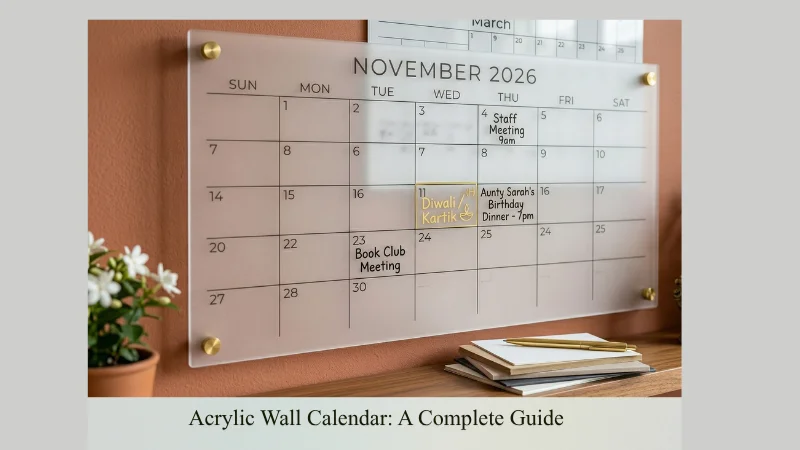
Acrylic Wall Calendar: The Complete Guide to Choosing, Styling & Using One in 2026
An acrylic wall calendar does something no paper calendar and no whiteboard can quite manage. It disappears into a room. The surface is clear or frosted. The frame — if there is one — is slim. The writing floats on the wall as if it grew there. And every month, you wipe it clean and begin again.
That quality — functional transparency, quiet presence, the ability to hold a month of planning without announcing itself — is why acrylic wall calendars have moved from niche craft market item to a mainstream home decor staple in less than five years.
If you’ve seen one mounted over a kitchen counter or above a home office desk and thought “I want that,” this guide explains everything: what to look for, what to avoid, how to use one properly, and why 2026 is a particularly interesting year to get one if your household runs on more than one calendar system.

WHAT AN ACRYLIC WALL CALENDAR ACTUALLY IS — AND WHY IT’S NOT A WHITEBOARD
People often confuse acrylic wall calendars with whiteboard calendars. They are related but built differently, and the difference matters for how they perform.
A whiteboard calendar uses a coated steel or melamine surface that accepts dry erase markers. An acrylic wall calendar uses a sheet of PMMA — polymethyl methacrylate, the material commonly called acrylic or Plexiglas — either clear, frosted, or tinted, usually between 3mm and 6mm thick. The surface is non-porous and glass-smooth, which means dry erase markers write on it cleanly and erase completely without ghosting — a chronic problem on lower-grade whiteboard surfaces.

This is the functional advantage that has made the acrylic calendar board so popular among people who used whiteboard calendars for a year, experienced ghosting, and started looking for something better. The acrylic surface performs like glass but weighs significantly less, mounts more easily, and doesn’t shatter.
The material also has an aesthetic quality that melamine simply doesn’t. Clear acrylic catches light. Frosted acrylic diffuses it softly. Both materials interact with a room’s lighting in ways that make the calendar feel designed rather than installed.
THE FOUR TYPES OF ACRYLIC WALL CALENDAR YOU’LL ACTUALLY ENCOUNTER
The market has consolidated around four distinct designs. Understanding which is which saves you from ordering something that looks beautiful in product photography and disappointing on your wall.

Clear Floating Acrylic Calendar
This is the original and still the most popular format. A clear acrylic sheet — usually 16×20 to 24×36 inches — is mounted directly to the wall with standoff hardware: small chrome or brass bolts that hold the panel a centimetre or two off the wall surface. The calendar grid is either printed on the back in reverse (so it reads correctly from the front) or written on the front with dry erase markers.
The “floating” effect — the slight gap between acrylic and wall, the shadow line it creates — gives these calendars a quality that looks significantly more expensive than it is. The wall colour shows through the clear surface, which means the calendar integrates visually with whatever room it’s in.
A clear wall calendar mounted against a white wall looks minimal and architectural. The same calendar mounted against a dark olive or charcoal wall becomes a design object. This adaptability is a genuine aesthetic advantage.
Frosted Acrylic Planner Wall
Frosted acrylic is also easier to photograph without glare, which explains why this format appears constantly in Instagram home decor feeds. The aesthetic wall planner look that has been trending since 2022 is almost exclusively frosted acrylic with printed grid lines and minimal typography.
Frosted acrylic diffuses light rather than transmitting it. The calendar content — grid lines, text, illustrations — is typically printed on the back of the panel and reads through the frosted surface with a soft, matte quality. This format is popular in Scandinavian-influenced interiors and home offices where a clean, non-reflective surface reads better under desk lighting.
Framed Acrylic Calendar
A framed wall calendar using acrylic as the viewing surface rather than glass is a different product from the floating panels above. These function like a poster frame — the calendar artwork or grid sits behind the acrylic, protected and visible. The frame is typically aluminium, wood, or black metal.
For anyone who wants a calendar that changes monthly with a printed design — botanical illustrations, watercolour artwork, photography — the framed format with calendar art inserts is an elegant solution that doesn’t require handwriting or markers at all.
The distinction matters for use: a framed acrylic calendar is not generally erasable. The writing surface is the frame’s backing, not the acrylic front. These are display calendars — you slide a new printed insert in each month, not erase and rewrite.
Tinted or Coloured Acrylic Panels
A newer entry in the market — acrylic panels in black, sage green, dusty pink, or navy that hold dry erase markers on their surface. These work like the clear floating panels functionally but create a specific colour statement on the wall. Black acrylic with white or gold dry erase marker is particularly popular in home offices and modern kitchens.
The risk with tinted panels is legibility. A dark acrylic surface requires high-contrast markers — neon or metallic — to be readable at a distance. Fine for a statement piece; more challenging as a daily functional planner.
SIZE GUIDELINES FOR AN ACRYLIC WALL CALENDAR THAT ACTUALLY WORKS
Acrylic calendars are sold in a range of sizes, and the temptation is always to go smaller because the product photos make every size look generous. Resist this.
For a household with two to four people using the calendar as a shared planning tool, a minimum of 24×18 inches is required. This gives each day in a monthly grid approximately 2.5×2 inches — enough for two or three legible entries without crowding.
For a home office where the calendar is primarily personal, 16×20 inches is adequate. The per-day cell will be tighter, but solo planning requires less space than family coordination.
For a kitchen or family command centre used by four or more people — or for anyone tracking multiple schedule streams, including both Gregorian and Hindi calendar dates — a 36×24 inch modern wall calendar is the entry point for comfortable use. Below this size, dual-system annotation becomes cramped and eventually stops happening.
A useful rule: every additional person whose schedule goes on the calendar adds approximately 6 inches of recommended width to your acrylic panel.
INSTALLATION: THE ONE STEP WHERE MOST PEOPLE GO WRONG

The floating standoff hardware that ships with most clear acrylic wall calendars looks straightforward. Four bolts, four holes, done. The complication is that acrylic panels — unlike wooden frames or fabric boards — have essentially no flex tolerance.
If your wall is not perfectly flat, or if the four standoff points are not perfectly level, the acrylic panel will be torqued slightly out of plane and will either crack over time at the mounting holes or develop a subtle bow that the panel never had before.
The correct installation sequence: mark all four mounting positions before drilling. Use a digital level to confirm they are level and square. Drill into studs or use appropriate drywall anchors rated for the panel weight. Acrylic panels up to 48×36 inches typically weigh under 4 kilograms — drywall anchors rated for 10kg per point are more than sufficient for most residential walls.
For the standoff bolts: hand-tighten only. Over-tightening cracks acrylic at the mounting hole. The panel should feel secure but not compressed at the bolt points.
One further detail: acrylic expands and contracts with temperature more than glass does — roughly 5x the thermal expansion coefficient. In rooms with significant temperature swings (garage offices, rooms near radiators, sunrooms), leave the mounting holes slightly oversized to allow for movement. Most quality acrylic calendars already account for this in their hardware, but check before installation.
WRITING ON ACRYLIC: WHICH MARKERS, WHICH COLOURS
Any dry erase marker writes on acrylic. Not all erase equally well.
Oil-based paint markers — the type used for chalkboard lettering — do not erase from acrylic without solvents. Do not use them, however tempting the thick, opaque line quality is for decorative headers.
Chalk markers fall in between. They write beautifully on acrylic with a semi-opaque, textured quality. They erase with a damp cloth on most acrylic surfaces, but on textured or frosted acrylic they can leave a faint residue that requires a mild screen-cleaning spray to remove completely. Test on a corner before committing to chalk markers on a frosted surface.
Standard Expo or Pilot dry erase markers erase completely from smooth acrylic with a dry cloth. For a clear floating panel, fine-tip dry erase markers in black, one accent colour, and a colour for each family member is the system that works most consistently over a full year of use.
For purely aesthetic use — a calendar wall art piece that changes monthly — metallic paint pens in gold or copper on black acrylic have a quality that photographs exceptionally well and creates a genuinely striking object in a room. This is the format most associated with the “influencer aesthetic wall planner” that has been popular on Instagram and Pinterest since 2022.
THE HINDI MONTH CONNECTION: WHY ACRYLIC WORKS FOR DUAL-CALENDAR HOUSEHOLDS
Indian households in the US, UK, Canada, and Australia often describe the same problem: they have two calendar systems they need to track — the Gregorian calendar for work, school, and appointments, and the Hindi lunar calendar for festivals, religious observances, and auspicious dates. Paper calendars handle one. Digital apps handle one. Nothing handles both visually and simultaneously.
An acrylic wall calendar with adequate surface area solves this in the most practical way. Use one marker colour for Gregorian entries. Use a second colour — traditionally saffron orange works beautifully against clear acrylic — exclusively for Hindi month start dates and festival markers.
When Chaitra begins on March 16, 2026, mark it in orange in the corner of that cell. When Adhik Jyeshtha — the rare 13th month in the 2026 Hindi calendar — runs from May 17 to June 15, mark those two dates in orange with a line connecting them: “Adhik Maas begins / ends.” When Diwali falls in Kartik month in early November, the orange marker places it in its lunar context alongside the Gregorian date.
This visual two-colour system on a clear or frosted acrylic planner wall requires no app, no separate panchang, and no cross-referencing. The two systems live on the same surface in visual harmony.
A complete list of all 13 Hindi month start dates for 2026 — including Adhik Jyeshtha — is available on the monthnameshindi.com Hindi month names guide, formatted specifically for manual annotation into any calendar format.
For 2026 specifically, the dual-colour system on an acrylic calendar board is more useful than in any recent year, because the extra month shifts festival dates significantly relative to their 2025 positions. A visual reminder on the wall prevents the confusion that inevitably follows when a family plans a puja date based on last year’s memory.
ACRYLIC VS GLASS VS WHITEBOARD: WHICH SURFACE IS RIGHT FOR YOU
Since we covered whiteboard surfaces in detail in the companion guide to dry erase wall calendars & also the digital wall calendar , the comparison here is focused: acrylic versus glass.
A glass wall calendar surface erases with the same completeness as acrylic and never ghosts. The difference is weight, cost, and installation complexity. A 24×18 inch glass panel weighs approximately three to four times more than the equivalent acrylic panel, requires stud mounting rather than anchor mounting, and costs significantly more.
Acrylic is the practical choice for most residential settings — lighter, safer (it doesn’t shatter under impact), easier to install, and more affordable. The aesthetic gap between acrylic and glass has narrowed considerably as manufacturing quality has improved. Side by side, a well-made 6mm acrylic panel is difficult to distinguish from glass.
Glass wins for permanence. If you want a calendar fixture that will outlast a decade of daily use in a high-traffic kitchen or office, glass is worth the installation investment. If you want something beautiful, functional, and practical for a home office or bedroom, acrylic delivers better value at every price point.
CLOSING: A CALENDAR THAT BELONGS IN THE ROOM
Most planning tools are tolerated in a room. They’re functional objects — stacks of paper, cork boards, plastic trays — that you look past rather than at. An acrylic wall calendar is different. Done well, it belongs in the room the way a print or a mirror belongs. It earns its wall space visually, not just functionally.
That is a meaningful thing to say about a planning tool. It means the calendar stays on the wall. It gets updated because it’s visible and because looking at it is pleasant. It becomes part of the daily rhythm of a household rather than something checked occasionally out of obligation.
In 2026, with a Hindi calendar year that is genuinely unusual — thirteen months, shifted festivals, a rare extra month that hasn’t appeared since 2023 — a wall calendar that invites daily engagement is not just a convenience. It’s how a family stays oriented together, across two calendar systems, through a year that doesn’t look quite like any recent one.
The acrylic surface makes that possible. The transparency makes it beautiful. The rest is markers, light, and the particular pleasure of writing something important on a wall that you know is both there and not there at the same time.