
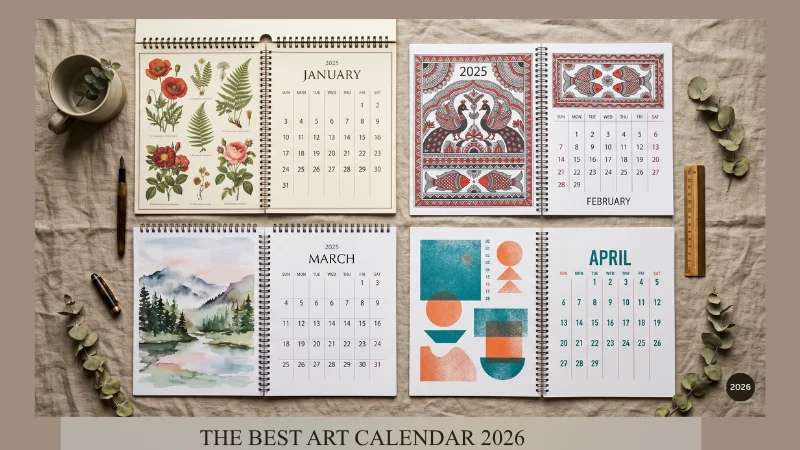
THE BEST ART CALENDAR 2026: FROM BOTANICAL PRINTS TO INDIAN MINIATURES
An art calendar does two things a regular calendar cannot. It counts the days, and it makes the days worth looking at. Every month you tear away a page, and there’s a small ceremony in it — the old image goes down, something new goes up, and your wall changes with the season before the season has even fully arrived.
That rhythm is older than digital planning.
Illustrated calendars were among the earliest mass-printed objects to combine utility with visual pleasure — the Très Riches Heures du Duc de Berry, created between 1411 and 1416 by the Limbourg brothers, is essentially a luxury art calendar commissioned for a French duke, each month depicted as a detailed scene of aristocratic and agricultural life that remains one of the most studied illuminated manuscripts in Western art history.
We’ve been hanging beautiful images next to our dates for six hundred years.
In 2026, the art calendar market is more varied and more interesting than it’s been in a decade — and harder to navigate as a result. This guide covers the major categories, the best publishers, the Indian artistic traditions that have made an unexpectedly strong entrance into the Western calendar market, and what to consider when buying an art wall calendar that genuinely earns twelve months on your wall.

WHY AN ART CALENDAR IS A DIFFERENT PURCHASE THAN A PLANNING CALENDAR
Most calendar buyers think about function first: does it have the right grid size, the right binding, enough space per day cell. The art calendar buyer thinks about presence. What will this look like on my wall in March? In August? Will I still want to see this in October?
That’s not a trivial question. A calendar occupies significant wall real estate for twelve months — or thirteen, in 2026’s unusual Hindi calendar year — and unlike a print or a painting, it changes monthly. The commitment is simultaneously longer and shorter than buying wall art outright. You live with each image for approximately four weeks, then release it.
This monthly turnover is what makes an illustrated calendar experientially distinct from other wall decor. It creates a seasonal rhythm that static art cannot. The floral wall calendar you hang in spring feels different from the autumn landscape you reveal in September from the same publisher. The year becomes curated.
The best art calendars understand this. They design across the year, not just page by page. The sequence of images matters — the emotional arc from January through December is a deliberate editorial decision in every well-made illustrated wall calendar, even if the buyer never consciously notices it.

THE MAJOR CATEGORIES IN 2026: WHAT’S ACTUALLY WORTH BUYING
Here we mention the major categories of Art wall calendar as of 2026.
Botanical and Floral Art Calendars
The botanical illustration tradition — scientific illustration of plants produced at museum-quality precision — has had a remarkable commercial revival over the past decade. Publishers like Pomegranate Arts (San Francisco) and Cavallini & Co. (also San Francisco, founded 1989) have led the market in licensed archival botanical prints reproduced as wall calendars.
A Cavallini and Co. calendar in the botanical format typically reproduces illustrations from the late 18th and early 19th centuries — the period when explorers and naturalists commissioned detailed plant illustrations as scientific records.
These images now function as home decor with provenance: every plate was once a scientific document, produced with extraordinary care by illustrators trained in both botany and fine drawing. Hanging one on your wall connects your kitchen to two hundred years of natural science.
Pomegranate calendars 2026 continue this tradition with an expanded range that includes contemporary botanical artists alongside archival work. Their production quality — offset printing on heavyweight stock with accurate colour reproduction — is the standard against which most illustrated wall calendars are measured.
Watercolour and Hand-Painted Illustration
The watercolour wall calendar occupies a different register than archival botanical work. Where botanical prints are precise and scientific, watercolour calendars are loose, expressive, and deliberately imperfect in a way that signals handmade authenticity. The visible brush marks, the soft edges, the way colour bleeds slightly at the boundary of a form — these qualities read as warmth in a home interior.
Etsy has become the dominant marketplace for independent artists selling watercolour art calendars in limited editions. A small studio artist in Edinburgh or Portland or Bangalore selling 200 copies of a hand-painted illustrated calendar 2026 occupies a market position that no large publisher can replicate: genuinely singular images, made by a named individual, sold directly to the person who will hang them.
The trade-off is consistency. A commercial art wall calendar from a major publisher is precisely printed, perfectly bound, and guaranteed to arrive looking exactly as shown. An Etsy art calendar is more individual and more vulnerable to the variabilities of small-batch printing and independent shipping. The buyer who understands this trades predictability for singularity — usually a worthwhile exchange.
Risograph Calendars: The Format Having Its Moment
Risograph printing — a stencil-based duplication process originally developed for office reproduction by Riso Kagaku in Japan in the 1970s — has become one of the most talked-about aesthetics in independent publishing over the past five years.
A risograph wall calendar has a characteristic look: flat, slightly translucent ink layers in a limited palette (often two or three colours), slight misregistration between layers that creates a handmade quality no digital printing achieves, and a tactile paper surface that feels nothing like standard commercial print stock.
The risograph art calendar is a collector’s object as much as a planning tool. Publishers and printmakers in Brooklyn, London, Amsterdam, and Tokyo produce annual risograph calendars in runs of 100 to 500. They sell out. They’re gifted between people who pay attention to design. They get framed after the year ends.
Vintage and Retro Wall Calendars
The vintage wall calendar draws on mid-century commercial illustration — travel posters, WPA art prints, Art Deco typography — as a design vocabulary. Retro wall calendar editions typically reproduce either original vintage illustrations in accurate facsimile or new work deliberately styled to period conventions.
The national parks wall calendar sits in this tradition — National Park Service interpretive art from the 1930s through 1950s, originally produced by artists employed under the New Deal’s Federal Art Project, remains some of the most widely reproduced Americana in the calendar market. The 2026 national parks editions from publishers including Browntrout and Willow Creek Press reproduce these images at print quality standards that do them justice.

INDIAN ARTISTIC TRADITIONS IN THE ART CALENDAR MARKET: AN UNDERSERVED AND GROWING SPACE
Here is where the art calendar conversation connects to something the Western calendar market has largely missed, and where the Indian diaspora audience has a genuinely underserved need.
Madhubani painting — the tradition originating in the Mithila region of Bihar, characterised by intricate geometric patterns, bold outlines, and images drawn from Hindu mythology and everyday rural life — is among the most visually distinctive artistic traditions in India.
Its formal qualities: flat planes of colour, dense interlocking pattern, a horror vacui approach to composition that leaves no surface unfilled. In the context of calendar wall art, Madhubani imagery is as immediately recognisable as Art Nouveau and as culturally specific as Ukiyo-e.
Warli painting, from the tribal communities of Maharashtra, uses white pigment on a dark background in geometric stick-figure compositions that depict festivals, harvests, and community life. The aesthetic is austere and rhythmic — immediately legible as art, immediately identifiable as from a specific cultural tradition.
Pattachitra, the scroll painting tradition of Odisha and West Bengal, depicts stories from the Jagannath cult and the Mahabharata in a narrative sequential format that translates naturally into a 12-month calendar structure. Each panel in a traditional Pattachitra scroll is a self-contained visual story. Each month in a Pattachitra-inspired art calendar could be exactly that.
What’s notable about these traditions in 2026 is their growing presence in mainstream Western design markets. Madhubani motifs appear in fabric collections from Anthropologie and West Elm. Warli-inspired prints have appeared in Etsy’s top sellers category multiple times.
Independent Indian artists on Society6, Redbubble, and their own Shopify stores are producing art wall calendars 2026 in these traditions at production quality that rivals established publishers.
For Indian diaspora households in the US and UK, an art calendar featuring Madhubani or Pattachitra imagery is not an ethnic niche purchase. It’s the same impulse that drives any art calendar buyer: I want something beautiful on my wall that means something, that connects me to something larger than the month I’m currently living through.
The connection to the Hindi month calendar is direct: Madhubani painting is inextricably tied to the lunar calendar of Mithila, where specific motifs are traditionally made during specific Hindi months.
Kohbar paintings, for example, are produced during the auspicious period of Vivah Panchami in Margashirsha month. The art and the calendar are not separate traditions — they grew from the same seasonal rhythm.
A full guide to the Hindi months and the festivals that defined these artistic traditions — Chaitra through Phalguna, with Adhik Jyeshtha in 2026 — is available at monthnameshindi.com, where the 13-month 2026 calendar provides the cultural context that makes an Indian art calendar calendar more than decorative.

WHAT TO LOOK FOR IN A WELL-MADE ART WALL CALENDAR
The difference between a beautiful art calendar and a disappointing one usually comes down to three things: paper stock, colour fidelity, and the size of the image area relative to the grid.
Paper stock is the foundation. An illustrated wall calendar printed on 70lb paper stock will look acceptably good in the shop and pale and thin on the wall. The same image on 100lb coated stock will hold its colour through eight months of light exposure and look like a proper art print. Most premium art calendars — Cavallini, Pomegranate, and independent fine art publishers — specify their paper weight. If a publisher doesn’t mention it, assume 80lb or less.
Colour fidelity matters especially for watercolour and botanical work, where the entire visual effect depends on subtle tonal gradation. Cheap offset printing compresses tonal range. Proper offset printing with careful colour separation preserves the softness of a watercolour wash or the botanical illustration’s delicate chromatic accuracy. Look for publishers who specify soy or vegetable inks, which hold colour more consistently than petroleum-based alternatives.
The image-to-grid ratio determines whether a calendar functions as wall art or merely a printed grid with decoration in the corner. The best art wall calendars allocate at least 60% of the page area to the illustration and a maximum of 40% to the date grid. Many commercial calendars reverse this ratio. When a calendar is described as an “art calendar” but the image is smaller than the date table, someone made a mistake in the design brief.
AFTER THE YEAR ENDS: WHAT TO DO WITH ART CALENDAR PAGES
This is the question that separates serious art calendar buyers from casual ones. A well-printed art calendar page — botanical illustration, Madhubani painting, risograph print, national parks poster — does not need to end its life in a recycling bin in January.
Calendar pages make excellent framed prints. Standard frame sizes (8×10, 5×7, 11×14) often correspond to calendar image dimensions when the date grid is trimmed. A botanical illustration from a Pomegranate calendar framed in a simple black floating frame is indistinguishable from a print purchased separately.
For Indian art calendar pages — Madhubani or Pattachitra illustrations — the pages have a secondary life as gift wrapping, card inserts, or as the backing for handmade notebooks and journals. The tradition of repurposing illustrated paper is old and honourable, and it changes the economics of an art calendar entirely: you’re not buying twelve months of decoration, you’re buying twelve illustrations, one of which happens to have a date grid below it.
CLOSING: THE MONTH THAT LOOKED BACK AT YOU
An art calendar is an accumulation of small visual experiences that only become visible in retrospect. In December, you can look back at what you lived with each month — the spring botanicals, the summer watercolours, the autumn mountain landscapes, the deep-winter illuminated manuscripts — and recognise in that sequence something about how the year actually felt.
That’s not a planning function. It’s a cultural function. The best art calendars don’t just mark time. They give time a texture, a colour, a specific visual weight that makes each month distinguishable from the one before it. You can also choose a huge wall calendar and adorn it as you like .
In 2026, with its unusual 13-month Hindi calendar year, the months carry more texture than usual for Indian households. Adhik Jyeshtha — the extra month, the lunar calendar’s way of catching up with the sun — runs from May 17 to June 15. For a household that understands what that means, a Madhubani art calendar marking that month with a kohbar motif would be more than decoration. It would be a calendar that knows what year it’s living in.
Also read our complete guide on Whiteboard wall calendar for more flexible approach towards organizing homes and offices .