
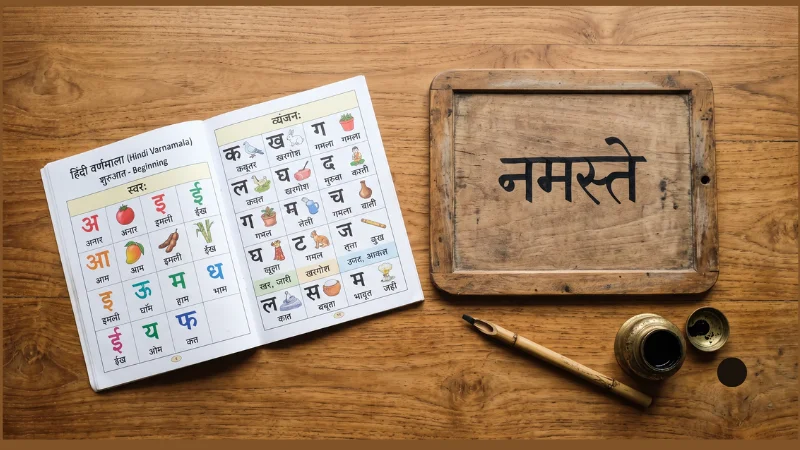
Hindi Numbers 1 to 100
हिंदी गिनती — १ से १०० तक
Every Hindi number from 1 to 100 in Devanagari script, Hindi word names, romanized pronunciation and English — the most complete Ginti reference online. Knowing these numbers will help you count the 12 Hindi month names .
100
Numbers Covered
4
Scripts Shown
10
Decade Groups
0
India Invented This

Hindi numbers are called Ginti (गिनती) — the Hindi word for counting. Hindi uses two parallel systems: Devanagari numerals (१, २, ३…) and Hindi word names (एक, दो, तीन…). Both are used in India — Devanagari numerals appear on official documents and currency, while Arabic numerals (1, 2, 3) are used in everyday contexts. From 1 to 99, each Hindi number has a unique word name that must be memorized. From 100 onward, the system becomes regular: सौ (sau = 100), हज़ार (hazaar = 1,000), लाख (lakh = 100,000), करोड़ (crore = 10,000,000).
📘 Reviewed against NCERT Hindi textbook standards|
🔄 Last updated: April 2026|
🕉️ Script verified: Devanagari Unicode-checked, native-speaker reviewed
शून्य
Zero (India’s invention)
.
99
Unique word names
सौ
100 = Sau
लाख
100,000 = Lakh
.
करोड़
10 million = Crore
.

Hindi has its own set of numerical symbols called Devanagari numerals. These are the official script-native digits used in Devanagari writing, distinct from the Arabic numerals (0–9) used globally.
अंक
Devanagari Numerals
— ० से ९ तक
India invented zero — and the world’s number system
The concept of zero (शून्य, shunya) was developed by Indian mathematicians, most notably Brahmagupta in 628 CE. The word “zero” itself traces to the Arabic sifr, which came from Sanskrit shunya. The positional decimal number system used globally today — including the numerals 1, 2, 3 you’re reading right now — originated in India and reached Europe via the Arab world. Every number on this page builds on that invention.
एक से दस
Hindi Numbers 1 to 10
— १ से १० तक
The first ten Hindi numbers are the foundation of the entire system. Every learner must memorize these before moving forward. The famous Bollywood phrase “Ek Do Teen Char” comes from this group.

| No. | Devanagari Numeral | Hindi Word | Romanized | Sounds Like |
|---|---|---|---|---|
| 1 | १ | एक | ek | ‘eck’ (short e) |
| 2 | २ | दो | do | ‘doe’ (rhymes with go) |
| 3 | ३ | तीन | teen | ‘teen’ (like teenage) |
| 4 | ४ | चार | chaar | ‘chaar’ (ch as in chair) |
| 5 | ५ | पाँच | paanch | ‘paanch’ (nasal n) |
| 6 | ६ | छह | chhe | ‘chheh’ (breathy ch) |
| 7 | ७ | सात | saat | ‘saat’ (long a) |
| 8 | ८ | आठ | aath | ‘aath’ (retroflex th) |
| 9 | ९ | नौ | nau | ‘now’ (rhymes with cow) |
| 10 | १० | दस | das | ‘duss’ (short u) |
ग्यारह से बीस
Hindi Numbers 11 to 20
— ११ से २० तक
This is the trickiest decade for beginners — every number from 11 to 19 has a unique, irregular form descended from Sanskrit. There is no pattern like “eleven, twelve, thirteen.” You must memorize each one. Also check our guide on the days of the week in hindi .

📌
Why 11–19 are irregular
Hindi inherited these forms directly from Sanskrit, which itself evolved them from Vedic Sanskrit. The number 11 (ग्यारह) traces to Sanskrit ekādaśa (one + ten), but the modern Hindi form has been compressed and changed over centuries. Similarly, 12 (बारह) traces to Sanskrit dvādaśa. The Sanskrit origins are still visible if you know what to look for — but in everyday Hindi, they must simply be memorized.

Gyaarah Se Bees
— The Irregular Teens
इक्कीस से तीस
Hindi Numbers 21 to 30
— २१ से ३० तक
The twenties group (bees group) builds loosely on इक + बीस, दो + बीस patterns — but each number has contracted and changed its form over centuries. You’ll notice “bees” (20) hidden in many of these: ik-kees (21), baa-ees (22), etc.

Ikkees Se Tees
— The Bees (Twenty) Groupइकतीस से पचास
Hindi Numbers 31 to 50
— ३१ से ५० तक
Two decades: the Tees (30) group and the Chalees (40) group. The pattern continues to be irregular — each number has its own form rather than following a simple “thirty-one, thirty-two” logic.

Ikatees Se Chalees
— Tees (30) GroupIktalees Se Pachaas
— Chalees (40) GroupAlso on this site: Hindi Month Names
Months in Hindi use these same number patterns — Maheena (month) 1, 2, 3… Learn both together.
इक्यावन से सौ
Hindi Numbers 51 to 100
— ५१ से १०० तक
The second half of the Ginti. The pattern from each root decade (60=saath, 70=sattar, 80=assi, 90=nabbe) echoes through its group — though each number still has its own contracted form.

Ikyavan Se Saath
— The Saath (Sixty) GroupIksath Se Sattar
— The Sattar (Seventy) GroupIkhattar Se Assi
— The Assi (Eighty) GroupIkyasi Se Nabbe
— The Nabbe (Ninety) GroupIkyaanve Se Sau
— The Sau (Hundred) GroupAlso on this site: Hindi Month Names
Months in Hindi use these same number patterns — Maheena (month) 1, 2, 3… Learn both together.
तर्क
The Logic Behind Hindi Numbers
Hindi numbers look irregular, but once you see the underlying logic, learning them becomes easier. The key is understanding what each decade root anchors.
The “una” prefix = one less
Many Hindi numbers use una (उन) to mean “one less than the next decade.” So उनतीस (unatees, 29) literally means “one less than 30 (tees).” Similarly उनचास (unachaas, 49) = “one less than 50 (pachaas),” उनसठ (59) = “one less than 60 (saath).” Once you spot this, 29, 39, 49, 59, 69 all make sense.

Decade roots to memorize
| बीस (20) | bees |
| तीस (30) | tees |
| चालीस (40) | chalees |
| पचास (50) | pachaas |
| साठ (60) | saath |
| सत्तर (70) | sattar |
| अस्सी (80) | assi |
| नब्बे (90) | nabbe |
| सौ (100) | sau |
The “ek” (one) pattern
| इक्कीस (21) | ik + bees |
| इकतीस (31) | ik + tees |
| इक्तालीस (41) | ik + chalees |
| इक्यावन (51) | ik + pachaas (altered) |
| इकसठ (61) | ik + saath |
| इकहत्तर (71) | ik + sattar |
| इक्यासी (81) | ik + assi |
| इक्यान्वे (91) | ik + nabbe |
Ek Do Teen — the Bollywood connection
The sequence “Ek Do Teen” (1, 2, 3) is one of the most recognized Hindi phrases worldwide, thanks to the iconic 1988 Bollywood film Tezaab. If you’ve heard this song, you already know your first three Hindi numbers. Similarly, “Teen Paanch Re” (3, 5) and countless other Hindi songs use number sequences — making music one of the best ways to internalize Ginti.
बड़ी संख्याएं
Beyond 100 — Big Numbers in Hindi
From 100 onward, Hindi numbers follow a regular, logical system. India uses its own large number system with Lakh and Crore — quite different from Western millions and billions.

Zero
शून्य
shunya
0 — India’s gift to mathematics
Hundred
सौ / एक सौ
sau / ek sau
100 — १००
Thousand
हज़ार
hazaar
1,000 — १,०००
Ten Thousand
दस हज़ार
das hazaar
10,000 — १०,०००
Lakh
एक लाख
ek lakh
100,000 — १,००,०००
Ten Lakh
दस लाख
das lakh
1,000,000 — १०,००,०००
Crore
एक करोड़
ek crore
10,000,000 — १,००,००,०००
Arab
एक अरब
ek arab
1,000,000,000 (1 Billion)
🇮🇳
India’s unique number system
India groups large numbers differently from the West. Instead of millions, billions and trillions, India uses lakh (1,00,000) and crore (1,00,00,000). All Indian financial reporting, government documents, currency, and everyday speech uses this system. A salary of “10 lakh” = ₹10,00,000. A company valued at “5 crore” = ₹5,00,00,000. Understanding lakh and crore is essential for reading Indian news, finance, and official statistics. Get to know about Ordinal numbers in hindi .
आगे क्या सीखें
Beyond Ginti — Related Number Concepts in Hindi
Counting (1–100) is the foundation, but “numbers in Hindi” covers more ground than Ginti alone. Here’s a direct answer to each related question, with a deeper guide linked for anyone who wants the full picture.

What is “Roll Number” in Hindi?
In everyday speech, most Indians simply say रोल नंबर (roll number) — it’s a common English loanword. On formal exam admit cards and school registers, the traditional Hindi terms क्रमांक (kramank) or अनुक्रमांक (anukramank) — both meaning “serial/sequence number” — are used instead.
What are Ordinal Numbers in Hindi?
Cardinal numbers (एक, दो, तीन = 1, 2, 3) count quantity. Ordinal numbers (पहला, दूसरा, तीसरा = 1st, 2nd, 3rd) show position or rank. Like cardinals, Hindi ordinals also change form irregularly as they climb — and even change endings by gender.
What are the Types of Numbers in Hindi?
Indian school maths uses precise Hindi terms: even = सम संख्या, odd = विषम संख्या, prime = अभाज्य संख्या, whole = पूर्ण संख्या, and rational = परिमेय संख्या. These appear throughout NCERT textbooks from Class 6 onward.
How do you say “Phone Number” or “Registration Number” in Hindi?
Spoken Hindi usually keeps the English word “नंबर” (number) for things like phone or account numbers. Formal documents switch to संख्या (sankhya) or क्रमांक (kramank) — for example, registration number becomes पंजीकरण संख्या.
प्रश्नोत्तर
Frequently Asked Questions
The most common questions about Hindi numbers — answered directly and clearly.
What are Hindi numbers 1 to 10?
Hindi numbers 1 to 10 are: 1=एक (ek), 2=दो (do), 3=तीन (teen), 4=चार (chaar), 5=पाँच (paanch), 6=छह (chhe), 7=सात (saat), 8=आठ (aath), 9=नौ (nau), 10=दस (das). These are the foundation of the Hindi number system and the ones most learners memorize first.
What is 21 in Hindi?
21 in Hindi is इक्कीस (ikkees). Its Devanagari numeral is २१. The word comes from ek (1) + a contracted form of bees (20). It’s one of the most searched Hindi numbers, partly because it’s a coming-of-age milestone number in Indian culture.
What is 25 in Hindi?
25 in Hindi is पच्चीस (pachees). Its Devanagari numeral is २५. In colloquial Hindi it’s also written as “pachis.” It’s a culturally significant number — 25 years of marriage is called “Silver Jubilee” (रजत जयंती) in India.
What is 67 in Hindi?
67 in Hindi is सड़सठ (sadsath). Devanagari numeral: ६७. It belongs to the 60s (saath) group. This is one of the specific number queries that appears often in search data — people writing formal Hindi documents or learning to say phone numbers in Hindi frequently look up exact number words.
What is zero in Hindi?
Zero in Hindi is शून्य (shunya) and its Devanagari numeral is ०. This is historically one of the most important words in mathematics — Indian mathematician Brahmagupta formalized the concept of zero in 628 CE. The Arabic word sifr (from which “zero” and “cipher” derive) was itself borrowed from Sanskrit shunya, meaning “empty” or “void.”
Are Hindi and Urdu numbers the same?
The spoken number words are largely the same — Hindi and Urdu share the same base vocabulary for numbers (ek, do, teen, chaar etc.) since they both descend from Hindustani. However, they use different scripts: Hindi uses Devanagari numerals (१, २, ३) and Devanagari script for the words, while Urdu uses Eastern Arabic/Indic numerals (۱, ۲, ۳) and Nastaliq script. For counting aloud, a Hindi and Urdu speaker count identically.
Why don’t Hindi numbers follow a regular pattern like English?
Hindi numbers from 1 to 99 are irregular because they evolved directly from Sanskrit, which itself evolved from Vedic Sanskrit. Each number contracted and changed over thousands of years of spoken use. English also has irregularities (eleven, twelve, thirteen) for exactly the same reason — they descend from Old English forms that haven’t regularized. From 100 onward, Hindi is completely regular: 100=sau, 200=do sau, 300=teen sau, etc.
What is lakh and crore in numbers?
A lakh (लाख) equals 100,000 (one hundred thousand). A crore (करोड़) equals 10,000,000 (ten million). India writes these with different comma placement: 1 lakh = 1,00,000 and 1 crore = 1,00,00,000. These units appear everywhere in Indian media, government, and daily life and are essential for understanding Indian finance and census data.
How do I say a number like 79 in Hindi?
79 in Hindi is उनासी (unaasi). Devanagari: ७९. The prefix “una” (उन) means “one less than” the next decade, so उनासी literally comes from “one less than 80 (assi).” This “una” pattern applies to 29 (unatees), 39 (unataalees), 49 (unachaas), 59 (unasath), 69 (unahattar), 79 (unaasi), and 89 (navasi — though this one has changed its form more significantly).
What is the difference between cardinal and ordinal numbers in Hindi?
Cardinal numbers (एक, दो, तीन = one, two, three) count quantity — this is what Ginti covers. Ordinal numbers (पहला, दूसरा, तीसरा = first, second, third) show order or position, and additionally change form based on gender (पहला/पहली). Both systems are irregular in their early numbers and need to be learned separately.
About This Guide
How this page was researched, checked, and kept current.
Sources cross-checked
Number words and Devanagari numerals were checked against NCERT Hindi textbooks (the standard used in Indian schools) and cross-referenced across multiple native-speaker usage examples for consistency.
Native-speaker review
Romanized pronunciations reflect standard Hindi (Manak Hindi) as spoken in most of North India. Regional dialects may pronounce a few numbers slightly differently — we’ve noted the two most common colloquial variants (e.g. pachees/pachis) where they occur.
Update policy
This guide is reviewed periodically for accuracy. Last full review: April 2026. If you spot an error in a word or numeral, it helps other learners if it gets fixed quickly.
Related guides on this site
This page is part of a growing Hindi Numbers hub. See the “Related Number Concepts” section above for ordinal numbers, roll number terminology, and Hindi math vocabulary.